How can I Sell Peptides, Skincare, and Supplements Online

Selling peptides, skincare, and supplements online is possible, but it is not the same as selling ordinary ecommerce products. The biggest mistake new brands make is treating peptides, cosmetics, and dietary supplements as one simple “wellness” category.
They are not.
A peptide serum, a collagen peptide powder, a vitamin supplement, and a research-use-only peptide may all use similar language in marketing, but they can fall into very different regulatory, advertising, payment, and platform-risk categories.
The short answer is this: you can sell peptide skincare, collagen peptides, and many supplements online if your product classification, labeling, claims, payment setup, and marketing channels are handled correctly. You should not sell prescription-style peptides, injectable peptides, or research-use-only products as human-use wellness products without proper legal, medical, and regulatory support.
This guide explains how to sell peptides, skincare, and supplements online without diluting your brand, overclaiming, or building a store that gets flagged before it scales.
Why This Market Is Different
The online health, beauty, and wellness market is still growing, but buyer skepticism is also much higher. Customers want clean ingredients, visible results, and trustworthy brands. Regulators and platforms want substantiated claims, clear labeling, and safe product positioning.
Most competitor guides cover basic steps like choosing a niche, building an ecommerce website, using social media, and finding a payment processor. Those are important, but they miss the real issue: your business model depends on what type of product you are selling and what you are claiming it does.
That is why a strong launch strategy starts with four questions:
- 1. What exactly is the product?
- 2. Is it a cosmetic, dietary supplement, research product, drug, or medical product?
- 3. What claims can you legally and safely make?
- 4. Which ecommerce, payment, and advertising channels will allow it?
FDA explains that dietary supplements are ingested products and are regulated differently from conventional foods and drugs; topical products, for example, are not dietary supplements.
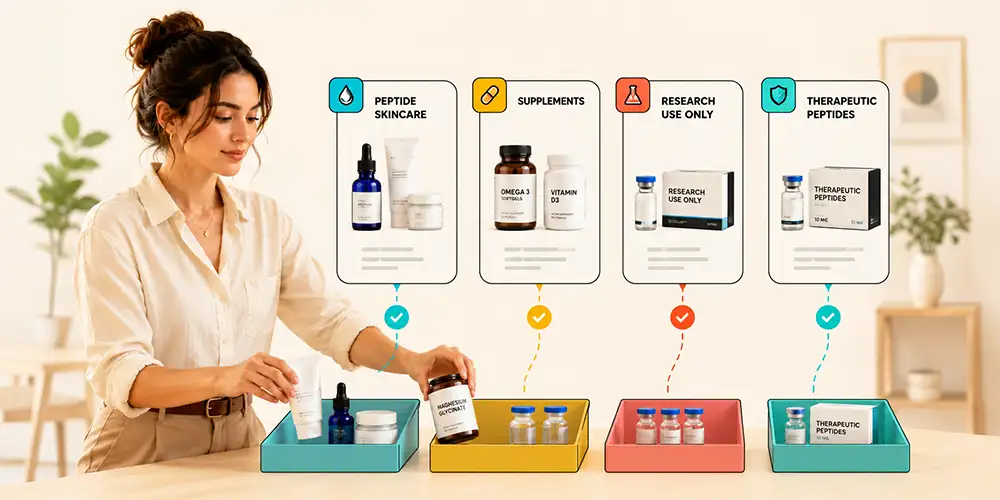
First, Separate the Product Categories
Before you build a Shopify store, write product descriptions, run Google Ads, or contact influencers, separate your products into clear categories.
1. Peptide skincare
This includes products such as peptide serums, copper peptide serums, barrier-support creams, eye creams, and anti-aging peptide skincare.
These products are usually positioned as cosmetics when they are designed to cleanse, beautify, promote attractiveness, or alter appearance. The safest skincare language focuses on visible or cosmetic outcomes, such as:
- Helps improve the appearance of fine lines
- Supports smoother-looking skin
- Helps skin feel more hydrated
- Supports the look of firmer, healthier skin
- Designed for a barrier-supporting skincare routine
The risk increases when product pages start sounding medical. Claims like “repairs tissue,” “rebuilds collagen,” “treats acne,” “heals eczema,” or “reverses aging” can push a skincare product into a higher-risk category.
2. Collagen peptides and ingestible beauty supplements
Collagen peptides are commonly sold as powders, capsules, sticks, drinks, or blends. These products usually sit in the dietary supplement category when they are intended to be swallowed and used to supplement the diet.
If you sell supplements online, your label, ingredient list, Supplement Facts panel, directions, warnings, and claims need to be carefully reviewed. FDA says supplement labels must include items such as the product name, a statement identifying it as a dietary supplement, the name and place of business of the manufacturer, packer, or distributor, a Supplement Facts panel, other ingredients, net quantity, and a domestic address or phone number for serious adverse-event reporting.
3. Vitamins, minerals, herbs, and wellness supplements
This includes products like magnesium, creatine, probiotics, fiber, protein, hair-skin-nails formulas, greens powders, and longevity supplements.
These can be strong ecommerce categories, but the same rule applies: avoid disease claims. A supplement can say it “supports normal immune function” if properly substantiated. It should not say it “prevents viral infections” or “treats autoimmune disease.”
FDA states that a dietary supplement represented explicitly or implicitly for treatment, prevention, or cure of a specific disease is considered a drug.
4. Research-use-only peptides
Research-use-only peptides are a separate category. These are not the same as collagen peptides or peptide skincare ingredients.
If a product is genuinely for laboratory research use only, the website must not market it for human use, fitness enhancement, fat loss, anti-aging, recovery, dosing, protocols, or personal wellness. A “research use only” disclaimer does not protect the business if the rest of the site implies human consumption.
5. Prescription or therapeutic peptides
Some peptides are associated with prescription medicine, compounding, telehealth, or clinical use. This is not normal DTC ecommerce.
If your business touches prescribing, dispensing, injectable products, compounded products, or patient treatment, you need specialized legal, medical, pharmacy, and payment guidance before selling online.

The Safest Way to Sell Peptides, Skincare, and Supplements Online
The safest way to start is not by asking, “What platform should I use?” The better question is, “What category am I legally and commercially prepared to sell?”
A practical launch path looks like this:
| Product type | Safer ecommerce path | Higher-risk path |
| Peptide skincare | Cosmetic positioning with appearance-based claims | Medical, wound-healing, acne-treatment, or collagen-regeneration claims |
| Collagen peptides | Dietary supplement with compliant label and substantiated claims | Weight-loss, joint disease, hormone, or cure claims |
| Vitamins/supplements | Structure/function claims with testing and disclaimers | Disease treatment claims or exaggerated transformation claims |
| RUO peptides | B2B research positioning with strict non-human-use language | Human-use, dosing, fitness, recovery, or anti-aging marketing |
| Therapeutic peptides | Licensed medical/pharmacy/telehealth model | Unlicensed DTC sale as a wellness product |
This distinction matters for SEO too. A page targeting “sell peptides online” can attract risky traffic if it does not clarify product type. A better SEO strategy is to create separate pages for peptide skincare, collagen peptides, supplement ecommerce, and research-use-only compliance.

Legal and Compliance Checklist Before Launching
This is where many new brands get stuck. They build the store first, then discover that their product pages, payment processor, ad account, or supplier documents are not ready.
Use this checklist before launch.
Product classification
Confirm whether the product is a cosmetic, dietary supplement, food, drug, device, research-use-only product, or prescription-related product. Do this before naming the product or writing claims.
Label review
For supplements, review the Supplement Facts panel, serving size, ingredient amounts, other ingredients, warnings, business information, net quantity, and adverse-event reporting contact information.
For cosmetics, review ingredient labeling, responsible person information, safety substantiation, product listing obligations, and MoCRA-related requirements where applicable. FDA notes that cosmetic product facility registration and product listing are now handled under MoCRA, with Cosmetics Direct available for submissions and 2026 updates supporting biennial registration renewal.
Claim substantiation
Do not publish health, wellness, skincare, or performance claims unless you have evidence to support them. FTC guidance says health-related product claims must be truthful, not misleading, and supported by science.
Supplier and manufacturing documentation
Ask for proof before you list products for sale. At minimum, collect:
- Certificate of Analysis, preferably batch-specific
- cGMP manufacturing documentation where applicable
- Heavy metals testing for ingestible products
- Microbial testing
- Allergen information
- Ingredient origin and specifications
- Stability or shelf-life information
- Recall procedure
- Packaging compatibility documentation
Payment processor approval
Peptides, supplements, nutraceuticals, and pseudo-pharmaceutical products can trigger payment processor review. Do not assume that because your store is live, your payment account is safe. Product pages, claims, chargeback risk, subscription terms, and refund policies can all affect approval.
Platform policy review
Google, TikTok, Shopify, Meta, Amazon, and affiliate platforms each have their own policies. Google restricts promotion related to prescription drug services and restricted drug terms, and advertisers may need certification depending on the product and location. TikTok Shop also provides specific guidance for health-related content and medical or weight-management claims in product listings, videos, and LIVE content.
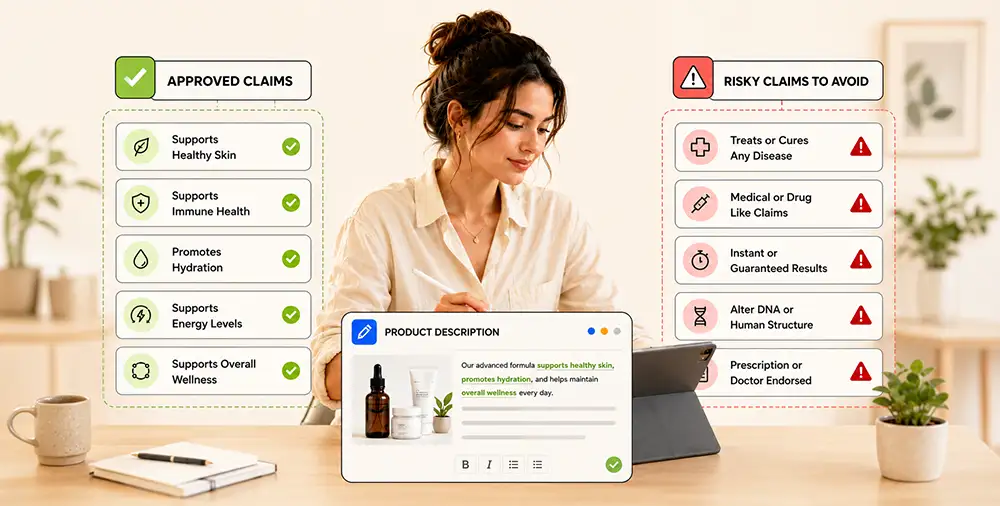
What Claims Can You Make?
Your claims are often the difference between a scalable ecommerce brand and a compliance problem.
Better skincare claim examples
Use language like:
- “Helps improve the appearance of fine lines.”
- “Supports a smoother-looking skin texture.”
- “Helps skin feel hydrated and refreshed.”
- “Designed to support the look of firmer skin.”
- “Pairs well with a barrier-first skincare routine.”
- Avoid language like:
- “Rebuilds collagen.”
- “Heals damaged skin.”
- “Treats acne.”
- “Repairs eczema.”
- “Reverses aging.”
The safest skincare product pages focus on cosmetic appearance, user experience, ingredients, and routine fit.
Better supplement claim examples
Use language like:
- “Supports healthy skin.”
- “Supports normal immune function.”
- “Supports muscle recovery after exercise.”
- “Supports healthy collagen formation.”
- “Helps fill common nutrition gaps.”
- Avoid language like:
- “Cures joint pain.”
- “Treats arthritis.”
- “Heals gut disease.”
- “Works like a GLP-1.”
- “Prevents illness.”
- “Melts fat.”
This is especially important for supplementing SEO. Ranking for high-intent keywords is useful only if your content does not create regulatory, platform, or payment risk.

How to Build the Ecommerce Website
A peptide skincare or supplement ecommerce website needs more trust than an ordinary beauty store. Buyers are not just asking, “Will this look good?” They are asking, “Can I trust this brand with something I put on or in my body?”
Your website should include these core pages:
| Page | Purpose |
| Homepage | Clarifies category, promise, proof, and audience |
| Product pages | Explain ingredients, use, testing, benefits, and disclaimers |
| Ingredient glossary | Builds SEO authority and buyer education |
| Testing/quality page | Shows COAs, cGMP, third-party testing, and safety standards |
| About page | Establishes founder story, expertise, and brand mission |
| FAQ page | Answers compliance-safe buyer questions |
| Contact page | Builds trust and supports customer service |
| Returns/refunds page | Reduces purchase hesitation |
| Privacy/terms pages | Required for ecommerce trust and ad platforms |
| Adverse-event reporting page | Important for supplement brands |
A strong product page should follow a simple flow:
- 1. What the product is
- 2. Who it is for
- 3. What category it belongs to
- 4. Key ingredients and amounts
- 5. How to use it safely
- 6. What it can reasonably support
- 7. What it does not claim to do
- 8. Testing and quality documentation
- 9. Reviews or professional proof
- 10. FAQ and disclaimer
Do not hide compliance language at the bottom of the page. Nowadays, transparency is part of conversion.
Choosing the Right Business Model
There is no single best business model for selling peptides, skincare, and supplements online. The right model depends on the product category, audience, compliance risk, and proof assets.
DTC skincare and supplement brand
This is the best path for brands selling peptide skincare, collagen peptides, ingestible beauty, and general wellness supplements.
It works well when you have:
- Clear product positioning
- Strong packaging
- Repeat purchase potential
- Educational content
- Reviews and proof
- Email/SMS retention
- Subscription or bundle offers
B2B research supplier
This model may fit legitimate research-use-only products sold to labs, universities, biotech companies, and qualified research buyers.
It requires a very different website language. The site should focus on purity, documentation, storage, specifications, and research suitability, not consumer benefits.
Medspa or practitioner-adjacent model
This can work well for skincare, post-treatment routines, and professional-grade wellness products. It is especially relevant in Los Angeles, where medspas, estheticians, longevity clinics, and beauty providers influence consumer trust.
Hybrid model
A hybrid model can work, but only if the funnels are separated. Do not mix consumer skincare claims, supplement claims, and research-use-only products on the same landing page. That creates confusion for buyers, search engines, payment processors, and compliance reviewers.
Platform and Payment Risk: What to Know Before You Scale
Many new founders ask, “Can I sell peptides on Shopify?” The more accurate answer is: it depends on the product, claims, payment processor, and policies being applied.
Shopify as a website platform is not the same as Shopify Payments, Shop app eligibility, ad platform approval, or merchant-account approval. You may be able to build an ecommerce site, but still face restrictions with payments, app visibility, advertising, fulfillment, or marketplace expansion.
For supplements and peptide-related products, check these areas before going live:
- Product category eligibility
- Payment processor terms
- Chargeback and refund policy
- Subscription billing terms
- Product-page claim language
- Ad landing page copy
- Email/SMS claims
- Influencer content
- Marketplace restrictions
- International shipping restrictions
If you sell supplements online, do not wait until your first ad rejection or processor hold to clean up your claims. Build the store as if a payment underwriter, platform reviewer, and skeptical buyer will all read it.
Marketing Strategy for Peptide Brands
The best marketing strategy for peptide skincare and supplements is education-first, proof-backed, and compliance-aware.
SEO
SEO should be the foundation because buyers research heavily before purchasing. Build content around search intent, not generic wellness inspiration.
Strong SEO topics include:
- How to sell peptides online legally
- Peptide skincare vs collagen peptides
- What are peptide serums?
- How to read a supplement COA
- What claims can supplement brands make?
- Best third-party tested supplements
- How to launch a skincare brand in California
- How to sell supplements online
- Peptide ecommerce compliance checklist
Each article should answer the question clearly, explain risk boundaries, and link to relevant product or service pages.
Social media
Social content should show the product in context without making unapproved claims.
Use:
- Routine videos
- Ingredient education
- Founder explainers
- Testing walkthroughs
- Packaging and fulfillment transparency
- Customer routine stories
- “What we do not claim” content
Avoid:
- Medical transformation claims
- Before/after claims that imply disease treatment
- Weight-loss promises
- Hormone claims
- “Doctor-approved” language without proof
- Influencer scripts that overstate outcomes
Email and SMS
Email and SMS should support education and retention, not pressure buyers with risky claims.
Use flows for:
- Welcome education
- Ingredient education
- Product usage guidance
- Replenishment reminders
- Review requests
- Abandoned cart trust-building
- Bundle recommendations
If your product is high-risk or highly regulated, aggressive promotional language can create more problems than sales.
Los Angeles and California Considerations
If you are launching a skincare or supplement brand in Los Angeles, your regional strategy matters.
LA has strong demand for beauty, wellness, fitness, longevity, medspa services, creator-led brands, and premium lifestyle products. But California also adds compliance layers that many generic ecommerce guides ignore.
If your business operates within the City of Los Angeles, the city states that companies doing business there need a Business Tax Registration Certificate. If you manufacture, pack, or hold dietary supplements in California, CDPH says you must have a valid Processed Food Registration.
For LA positioning, the strongest angles are usually:
- “Camera-ready skin.”
- “Barrier-first skincare.”
- “Third-party tested wellness.”
- “Clean, transparent supplement routines.”
- “California-compliant beauty and wellness ecommerce.”
- “Professional-grade skincare without medical overclaims.”
Local partnership opportunities include medspas, estheticians, dermatology-adjacent creators, pilates studios, recovery studios, clean beauty pop-ups, gyms, and longevity-focused clinics.

COLAB: How Local Brands Can Turn Compliance Into a Growth Advantage
For a Los Angeles wellness brand, compliance should not feel like boring legal housekeeping. It can become part of the brand story.
A COLAB LAX-style launch strategy should combine brand positioning, web design, SEO, paid media, content, and conversion strategy around one central promise: trust before scale.
COLAB Los Angeles positions its services around strategy, branding, web/mobile design, development, paid search, paid social, SEO, content, email/SMS, and creative production. For peptide skincare, supplement, and wellness ecommerce brands, that combination matters because the website, ads, product pages, and creative all need to tell the same compliant story.
A smart COLAB launch plan would include:
- Product category audit
Clarify whether the offer is skincare, dietary supplement, research-use-only, practitioner-led, or prescription-adjacent. - Claims map
Separate safe claims, risky claims, forbidden claims, and claims that need stronger substantiation. - Product page buildout
Create SEO-friendly pages that explain ingredients, benefits, quality, testing, and usage without overclaiming. - Compliance-safe creative
Build Meta, Google, TikTok, landing page, and influencer content around education, routine, proof, and lifestyle instead of unsupported health promises. - Local LA growth strategy
Use local SEO, medspa partnerships, creator content, pop-ups, and professional beauty/wellness partnerships to build trust before scaling national ads. - Conversion and retention system
Add email/SMS flows, subscriptions, bundles, quizzes, and replenishment reminders after the claim language and payment setup are stable.
The brands that win in LA will not be the ones shouting the biggest claims. They will be the ones that look premium, explain clearly, show proof, and make buyers feel safe purchasing.
Step-by-Step Launch Plan
Phase 1: Product and compliance foundation
Start with the product, not the logo.
Clarify:
- Product category
- Intended use
- Target buyer
- Supplier documentation
- Label requirements
- Claim boundaries
- Testing requirements
- Payment processor fit
- Platform risk
- State and local requirements
This phase prevents expensive rebuilds later.
Phase 2: Website and offer build
Build the store around trust.
- Your offer should be simple:
- “Here is what this product is.”
- “Here is who it is for.”
- “Here is what it supports.”
- “Here is the proof.”
- “Here is what it does not claim to do.”
- “Here is how to buy safely.”
For peptide skincare and supplements, clarity converts better than hype.
Phase 3: SEO and education content
Create a content hub before pushing aggressive paid ads. Start with comparison, ingredient, safety, and compliance-friendly content.
Good examples:
- Peptide Serum vs Collagen Peptides: What Is the Difference?
- How to Read a Certificate of Analysis for Supplements
- What Does Third-Party Tested Mean?
- How to Choose a Peptide Skincare Product
- What Supplement Claims Should You Avoid?
- How to Sell Supplements Online in California
This content supports SEO, AEO, buyer trust, and sales-team education.
Phase 4: Paid media and creator testing
Once your product pages are compliant and your payment setup is stable, test paid channels carefully.
Start with lower-risk creative:
- Ingredient education
- Routine demonstrations
- Founder videos
- Testing transparency
- Customer experience stories
- “What to look for before buying” videos
Avoid starting with extreme claims, weight-loss messaging, medical benefits, or aggressive before/after content.
Phase 5: Retention and scale
After the first conversion data comes in, optimize:
- Product bundles
- Subscriptions
- Replenishment emails
- Review generation
- Loyalty offers
- Practitioner partnerships
- Wholesale inquiries
- Local LA collaborations
For supplements and skincare, repeat purchase is often where the profit is. Your launch should be built for lifetime value, not just first-order revenue.
Common Mistakes That Get Brands Flagged
Many peptide, skincare, and supplement brands fail because of avoidable mistakes.
The most common are:
- Selling research-use-only peptides with human-use language
- Claiming a product treats, cures, or prevents disease
- Using “before and after” content that implies medical results
- Launching without COAs or testing documentation
- Copying competitor claims without verifying legality
- Running ads before payment processor approval
- Using TikTok or Meta creators without claim guidelines
- Calling a product “natural Ozempic” or “GLP-1 alternative”
- Selling supplements without label review
- Combining skincare, supplements, and medical peptide language on one page
- Hiding disclaimers while making aggressive claims elsewhere
A brand can recover from weak design. It is much harder to recover from payment holds, ad account bans, regulatory letters, or customer trust issues.
Final Takeaway
Selling peptides, skincare, and supplements online is not just an ecommerce project. It is a product classification, claims, proof, payment, platform, and trust-building project.
The brands that win will not be the ones making the loudest promises. They will be the ones that clearly explain what they sell, show documentation, avoid risky claims, respect platform rules, and build a buyer experience that feels safe from the first search to the final checkout.
A good rule is simple: before you scale traffic, make sure your product category, claims, testing, payment setup, and website can survive review. That is how you build a peptide skincare or supplement brand that can actually last.
FAQs
Can I sell peptides online legally in 2026?
Some peptide-related products can be sold online, but the answer depends on the product type and intended use. Peptide skincare and collagen peptide supplements are different from research-use-only peptides or prescription-related peptides. The safest first step is to classify the product before writing product pages, ads, or checkout language.
Can I sell peptide skincare online?
Yes, peptide skincare can often be sold online as a cosmetic if the claims remain cosmetic and appearance-based. Avoid language that says the product treats disease, repairs tissue, heals skin conditions, or creates drug-like effects.
Are collagen peptides supplements?
Collagen peptides are commonly sold as dietary supplements when they are intended to be swallowed. That means supplement labeling, ingredient disclosure, manufacturing standards, and claim substantiation matter.
Do I need FDA approval to sell supplements online?
FDA generally does not approve dietary supplements before they are marketed, but manufacturers and distributors are responsible for safety, labeling, good manufacturing practices, and compliance. FDA can take enforcement action when products are adulterated, misbranded, or marketed with improper claims.
What claims can I make for supplements?
You can generally make truthful, non-misleading, substantiated structure/function-style claims, such as “supports healthy skin” or “supports normal immune function,” when properly supported and labeled. Do not claim that a supplement treats, cures, or prevents a disease.
Can I sell research peptides to consumers?
Research-use-only peptides should not be marketed for human consumption, dosing, fitness, anti-aging, fat loss, injury recovery, or wellness outcomes. If your product is for research use only, the entire website, not just the disclaimer, must support that positioning.
Can I advertise peptide or supplement products on Google?
It depends on the product and claims. Google restricts healthcare, medicines, prescription drug services, and restricted drug terms. Review the policy before building campaigns or landing pages.
Can I sell supplements on TikTok Shop?
Some wellness products may be allowed, but TikTok Shop has strict policies around health-related content, medical claims, and weight-management claims. Review product, listing, video, and LIVE content rules before launching.
What do I need to sell supplements in California?
If you manufacture, pack, or hold dietary supplements in California, CDPH says you need a valid Processed Food Registration. If you operate in the City of Los Angeles, you may also need a Business Tax Registration Certificate.
What is the safest way to start?
Start with a lower-risk category like peptide skincare, collagen peptides, or a clearly defined supplement product. Build the store around compliant claims, testing documentation, transparent labels, payment approval, and education-first marketing before scaling ads.