How to Advertise Peptides on Google Without Getting Banned

Google’s most asked question is: Can You Advertise Peptides on Google?
The answer is yes, but not the way most peptide brands try to do it.
The safest way to advertise peptides on Google is to promote a compliant consultation, eligibility review, research-use documentation process, or physician-supervised service, not direct peptide sales, drug-like claims, dosing instructions, or “buy peptides online” pages.
Google restricts healthcare and medicines advertising, including prescription drug services, restricted drug terms, unauthorized pharmacies, unapproved substances, and speculative or experimental treatments. Google also reviews more than just your ad text. It can evaluate your landing page, site, app, services, products, account, and third-party signals when deciding whether your peptide Google Ads are compliant.
That means “How to advertise peptides on Google without getting banned” is the wrong question if you are looking for a loophole. The better question is:
How do we build a Google Ads funnel that does not look like unsafe drug promotion, unauthorized prescribing, unapproved medical treatment, or misleading healthcare advertising?
This guide answers that question.

Why Peptide Google Ads Are So Easy to Get Wrong
Peptide advertising sits in a difficult overlap between wellness marketing, pharmaceutical policy, telehealth, research chemicals, longevity clinics, compounding pharmacies, fitness recovery, and medical weight loss.
That is why peptide ads get disapproved even when the advertiser thinks the copy is “clean.”
A peptide clinic may think it is advertising a wellness consultation. Google may see online prescribing, medical treatment claims, restricted drug terms, or a destination that appears to facilitate prescription drug access.
A research peptide supplier may think “for research use only” is enough. Google or FDA may see consumer-facing language, dosing cues, transformation claims, or pages that imply human use.
A med spa may think “peptide therapy Los Angeles” is just a local service keyword. Google may see a healthcare service that requires certification, careful location targeting, and a compliant landing page.
The biggest mistake is treating peptide advertising like normal PPC. It is not. Google’s healthcare and medicines policies say some healthcare-related content cannot be advertised at all, while other content can only be advertised in certain locations by approved advertisers.
So the campaign has to be built from the start around compliance, not repaired after the account gets flagged.
What Competitors Usually Miss About Peptide Advertising
Most content on peptide advertising falls into one of two categories.
The first category gives broad advice like “use compliant language,” “avoid claims,” and “focus on research use.” That is directionally useful, but it does not explain how Google evaluates the full campaign ecosystem.
The second category gives more practical Google Ads advice, such as building research-use landing pages, writing outcome-adjacent copy, and using negative keywords. Oney’s guide, for example, discusses peptide ad complexity, compliant account structure, ad-copy frameworks, landing page alignment, and account health.
The problem is that many guides still do not go far enough on official Google policy,

certification, restricted drug terms, personalized advertising limits, FDA enforcement trends, or local healthcare nuances in markets like Los Angeles.
This guide focuses on the missing layer: how to structure the offer, page, keywords, claims, and funnel so Google sees a compliant healthcare or research pathway, not a risky peptide sales operation.
The Basic Rule: Advertise the Process, Not the Peptide
If you remember one thing from this guide, make it this:
Do not lead with the peptide. Lead with the compliant process.
For a peptide clinic, the process may be a physician-supervised peptide therapy consultation, lab-guided wellness evaluation, medical history review, or eligibility screening.
For a telehealth provider, the process may involve licensed-provider review, appropriate certification, prescription-service compliance, and transparent fulfillment rules.
For a research supplier, the process may be commercial lab qualification, COA documentation, research-use restrictions, and non-consumer positioning.
The ad should not say:
- “Buy BPC-157 online.”
- “Peptides for injury recovery.”
- “Lose weight fast with peptide injections.”
- “No prescription needed.”
- “Research peptides for human use.”
- “Compounded Ozempic alternative.”
The safer framing is:
- “Physician-supervised peptide therapy consultation.”
- “Lab-guided wellness evaluation in Los Angeles.”
- “Eligibility-based peptide therapy consultation.”
- “Research-use peptides with COA documentation for qualified labs.”
- “Google Ads compliance audit for peptide clinics.”
This is not about hiding what you do. It is about presenting the service accurately, legally, and in a way that does not trigger pharmaceutical or unapproved-substance red flags.

The Policies That Matter Most for Peptide Google Ads
Google does not have one single “peptide ads policy.” Instead, peptide advertising can trigger several overlapping policies.
Prescription Drug Services
Google restricts ads related to the online prescribing, dispensing, and sale of prescription drugs. This includes online pharmacies and telemedicine providers. Google says it determines whether an advertiser is promoting prescription drug services by looking at the ad, website, app, products, and services offered. It also says it errs on the side of caution, especially when landing pages appear to facilitate online prescription, dispensing, or sale of medicines.
This matters if your peptide funnel includes online consultations, prescription access, pharmacy fulfillment, compounded products, or treatment plans.
Restricted Drug Terms
Google restricts prescription drug terms in ads, landing pages, and keywords. In the United States, Canada, and New Zealand, prescription drug terms may be used for promotional purposes in accordance with local law, but certification is required to keyword-target those terms. Certain business types, including telemedicine providers, online pharmacies, and pharmaceutical manufacturers, also require certification.
This matters if your campaign targets terms such as semaglutide, tirzepatide, GLP-1, prescription product names, or other drug-related keywords.
Unapproved Substances
Google does not allow promotion of certain products even if they are claimed to be legal. This includes products that imply they are as effective as prescription drugs or controlled substances, and some non-approved products marketed as safe or effective for preventing, curing, or treating disease.
This matters if your ad or landing page says peptides can heal injuries, reverse aging, burn fat, treat disease, repair joints, improve hormones, or replace prescription therapy.
Pharmaceutical Manufacturer Rules
Google allows pharmaceutical manufacturers to advertise only in select locations, and pharmaceutical manufacturers must be certified by Google before serving ads. Prescription drug promotion by pharmaceutical manufacturers is limited to Canada, New Zealand, and the United States.
This matters if your business model looks like manufacturing, distributing, or directly promoting pharmaceutical products.
Health in Personalized Advertising
Google treats health as a sensitive interest category. It includes personal health content, chronic health conditions, medical procedures, and injections. Google says advertiser-curated audiences cannot be used when promoting sensitive interest categories, and it lists Customer Match, your data segments, audience expansion, and lookalike segments as not supported for these categories.
This matters because many peptide advertisers get into trouble after search traffic by trying to retarget visitors, upload lead lists, or build lookalike audiences from health-interest behavior.
The 2026 FDA Context Peptide Advertisers Cannot Ignore
Even though Google Ads policy and FDA regulation are different systems, they influence the risk environment.
In March 2026, FDA announced warning letters to 30 telehealth companies for false or misleading claims regarding compounded GLP-1 products offered on their websites. FDA also said it is paying close attention to misleading claims by telehealth and pharma companies across media platforms.
FDA has also warned about illegal online sales of semaglutide and tirzepatide, saying illegally marketed drugs may be counterfeit, contain the wrong ingredients, contain harmful ingredients, or contain too little, too much, or no active ingredient. FDA urges consumers to buy only from state-licensed pharmacies.
This is important for peptide advertisers because GLP-1 marketing, peptide therapy, medical weight loss, compounding, and telehealth often overlap in the same funnels. If your landing page looks like aggressive direct-to-consumer pharmaceutical marketing, you create both regulatory and platform risk.
A common misconception is that “for research purposes only” or “not for human consumption” automatically protects a peptide advertiser. FDA has specifically warned companies about products containing semaglutide, tirzepatide, or retatrutide that were labeled this way while being sold directly to consumers with human-use cues or dosing instructions.
So the rule is simple:
Your full funnel must match your stated positioning.
If you say research-use only, the site, checkout flow, audience, content, product pages, and ad copy must look research-use only.
If you say physician-supervised care, the page must show real medical oversight, accurate licensing, compliant claims, and an appropriate consultation process.
Who Can Advertise Peptides on Google?
There is no one-size-fits-all answer because Google will evaluate what your business actually does.
A peptide therapy clinic is not the same as a research peptide supplier. A telemedicine platform is not the same as a local longevity clinic. A compounding pharmacy is not the same as a marketing agency helping peptide clinics fix disapproved ads.
The risk changes based on advertiser type.
Peptide therapy clinics can often build safer campaigns around consultation intent, such as “peptide therapy consultation,” “physician supervised peptide therapy,” “lab guided peptide therapy,” or “peptide clinic Los Angeles.” The landing page should focus on medical evaluation, eligibility, provider review, and patient education—not direct peptide sales.
Telehealth peptide providers are higher-risk because online prescribing, medication access, and fulfillment can trigger prescription drug service rules. Certification and legal review may be required before running Google Ads.
Research peptide suppliers need to keep the entire funnel clearly research-oriented. That means no consumer transformation language, no fitness recovery claims, no dosing instructions, no “for human use” implication, and no wellness outcome promises.
Compounding pharmacies and pharmaceutical-adjacent brands need even stricter review because certification, jurisdiction, pharmacy licensing, and claim accuracy matter. If the funnel promotes online prescription, dispensing, sale, or distribution, Google may treat it under prescription drug service or pharmacy-related rules.
Agencies and consultants can usually advertise educational or B2B services around peptide Google Ads, peptide landing page compliance, peptide advertising restrictions, or Google Ads for peptide clinics, as long as the page does not itself promote unsafe drug claims.

The Safe Keyword Strategy for Peptide Google Ads
Keyword risk is not only about the words themselves. It is about the relationship between the keyword, the ad copy, the landing page, the business model, and the user’s likely intent.
A keyword like “peptide therapy Los Angeles” may be acceptable for a compliant clinic consultation page, but risky if it leads to a page with product names, pricing, dosing, and “start injections today” language.
A keyword like “buy BPC-157 online” is dangerous because the intent is direct product purchase, and the page will likely look like online sale of a regulated or unapproved substance.
A keyword like “peptide Google Ads agency” is safer for a marketing agency because the intent is B2B advertising help, not patient access to peptides.
Safer Keyword Themes
Use these for compliant Search campaigns and SEO pages when the destination supports the intent:
- peptide therapy consultation
- physician supervised peptide therapy
- lab guided peptide therapy
- peptide clinic Los Angeles
- peptide therapy Los Angeles
- longevity clinic Los Angeles
- medical wellness consultation
- recovery wellness clinic
- hormone and wellness clinic
- peptide advertising compliance
- peptide landing page compliance
- Google Ads for peptide clinics
- peptide ads disapproved
- peptide marketing compliance
These keywords work best when the landing page explains the consultation process, qualification criteria, provider oversight, and compliance boundaries.
Risky Keyword Themes
Use caution with:
- peptide therapy
- peptide treatment near me
- BPC-157 therapy
- CJC-1295 clinic
- Ipamorelin clinic
- semaglutide consultation
- tirzepatide consultation
- compounded GLP-1 clinic
These terms may require certification, tighter claims review, or a different funnel structure depending on the business model.
Dangerous Keywords to Avoid or Negative-Match
Most peptide advertisers should avoid or negative-match:
- buy peptides online
- no prescription peptides
- research peptides for human use
- BPC-157 buy
- TB-500 buy
- peptide dosage
- peptide vial
- cheap peptides
- peptides for bodybuilding
- peptides for injury healing
- Ozempic alternative
- compounded Ozempic
- compounded Mounjaro
These terms pull the campaign toward direct sales, dosing, unauthorized drug access, bodybuilding use, or treatment claims.

The Compliance-First Funnel That Reduces Ban Risk
A safer peptide Google Ads funnel does not start with “peptides for sale.” It starts with the correct offer.
For clinics, the strongest funnel is:
Search ad → educational consultation page → eligibility form → licensed provider consultation → treatment discussion only if clinically appropriate.
The ad sells the consultation. The landing page explains the process. The form screens for fit. The provider handles medical judgment.
That is much safer than:
Search ad → product page → before/after claims → price list → checkout.
For research peptide suppliers, the stronger funnel is:
Search ad → research-use category page → COA documentation → lab/business qualification → compliant purchase flow.
The page should not look like it was written for biohackers, athletes, bodybuilders, weight-loss shoppers, or injury-recovery patients.
For marketing agencies, the safer funnel is:
Search ad → peptide Google Ads compliance audit page → keyword/ad/landing page review → strategy call.
This is where terms like “peptide ads disapproved,” “peptide landing page compliance,” and “Google Ads for peptide clinics” can be used naturally without promoting peptide consumption.
Landing Page Compliance: What Google Reviews After the Click
Your landing page matters as much as your ad copy.
Google’s prescription drug services policy says it may look at the content of your ads, site, app, products, and services offered. It also says it errs on the side of caution when landing pages appear to facilitate online prescription, dispensing, or sale of medicines.
So a clean ad cannot save a risky page.
A compliant peptide landing page should clearly explain who the business serves, what the user can do next, what claims are not being made, and what process must happen before any treatment or purchase.
For a peptide clinic, the page should include provider credentials, consultation steps, lab guidance if applicable, medical history review, risk screening, privacy policy, terms, physical service area, and a clear disclaimer that eligibility and treatment decisions require provider review.
For a research supplier, the page should include research-use language, COA access, business or lab qualification details, clear restrictions, and no human outcome claims.
For an agency like COLAB LAX, the page should explain the advertising audit process, not make promises like “guaranteed approval” or “ban-proof peptide ads.”
The CTA should match the compliant action:
- “Book a consultation.”
- “Check eligibility.”
- “Request a compliance audit.”
- “Review the consultation process.”
- “Request COA documentation.”
Avoid CTAs like:
- “Buy now.”
- “Start peptides today.”
- “Get injections shipped.”
- “No prescription needed.”
- “Order BPC-157.”
Ad Copy That Reduces Policy Risk
The safest peptide ad copy is process-based, credibility-based, and specific without making medical promises.
Instead of writing:
- “Heal faster with BPC-157.”
Write:
- “Physician-supervised peptide therapy consultation in Los Angeles.”
Instead of:
- “Lose weight fast with peptide injections.”
Write:
- “Medical weight management consultation with licensed providers.”
Instead of:
- “Buy research peptides for recovery.”
Write:
- “Research-use peptides with COA documentation for qualified labs.”
Instead of:
- “Peptide ads that never get banned.”
Write:
- “Peptide Google Ads compliance audit for clinics and wellness brands.”
The difference is not cosmetic. The safer version changes the offer from a risky outcome claim to a compliant next step.
Good peptide ad copy should emphasize:
- licensed provider review
- eligibility-based care
- lab-guided wellness consultation
- transparent documentation
- research-use qualification
- compliant campaign audit
- landing page claim review
- negative keyword cleanup
- Google Ads healthcare policy review
Do not use language that implies guaranteed outcomes, drug-like effectiveness, disease treatment, or unauthorized access.
Recommended Campaign Structure for Peptide Brands
Start narrower than you think.
Do not launch broad-match peptide campaigns, Shopping campaigns, Performance Max, Display remarketing, and YouTube all at once. In this category, speed can create review problems faster than it creates revenue.
A safer structure starts with Search.
Campaign 1: Brand Search
Use this to protect branded demand. Target your clinic name, doctor name, agency name, product brand if legally appropriate, and branded variations.
This campaign should lead to a compliant homepage, consultation page, or audit page.
Campaign 2: Consultation Search
Use keywords like “peptide therapy consultation,” “peptide clinic Los Angeles,” “physician supervised peptide therapy,” “lab guided peptide therapy,” and “longevity clinic Los Angeles.”
This should lead to a consultation page, not a product page.
Campaign 3: Education Search
Target searches like “how to choose a peptide clinic,” “is peptide therapy legal,” “peptide therapy consultation process,” “peptide advertising restrictions,” and “peptide Google Ads policy.”
This supports cautious buyers who are not ready to convert yet.
Campaign 4: B2B Compliance Search
This is ideal for agencies and consultants. Target “peptide Google Ads agency,” “peptide ads disapproved,” “peptide landing page compliance,” “Google Ads for peptide clinics,” and “peptide marketing compliance.”
This campaign can promote an audit or strategy call.
What Not to Launch First
Do not begin with Shopping campaigns for peptide products unless your legal and policy review is extremely strong.
Do not use Customer Match, remarketing lists, your data segments, or lookalikes for health-sensitive peptide traffic. Google’s health personalized advertising policy lists these advertiser-curated audiences as not supported for sensitive health categories.
Do not send broad peptide traffic to pages with dosing, product pricing, product names, or transformation claims.
Negative Keywords for Peptide Google Ads
Negative keywords are not only a performance tool. In peptide advertising, they are also a compliance filter.
Start with these categories.
- Direct purchase negatives: buy, for sale, cheap, coupon, discount, wholesale, bulk, vial, powder, raw, lyophilized, supplier, overseas, China, free shipping.
- Prescription-risk negatives: no prescription, without prescription, dosage, dose, dosing, protocol, injection instructions, how to inject, syringe.
- Bodybuilding negatives: bodybuilding, steroid, muscle gain, cutting, bulking, HGH, anabolic, fat loss stack.
- Medical-claim negatives: cure, heal, injury repair, tendon repair, arthritis, diabetes, cancer, autoimmune, depression, anti-inflammatory.
- High-risk product negatives: BPC-157 buy, TB-500 buy, melanotan, retatrutide, cagrilintide, compounded Ozempic, Ozempic alternative, Mounjaro alternative.
This list should be reviewed every week in the search terms report. If Google starts matching your ads to unsafe intent, fix it before the account accumulates repeated disapprovals.
Why Retargeting Is Riskier Than Most Peptide Advertisers Realize
Many advertisers assume retargeting is easy money.
In peptide advertising, it may be the easiest way to create policy risk.
Health is a sensitive interest category under Google’s personalized advertising rules. Google specifically includes invasive medical procedures and injections in health-sensitive content, and it says advertiser-curated audiences cannot be used when promoting sensitive categories. Customer Match, your data segments, audience expansion, and lookalike segments are listed as not supported.
That means a peptide clinic should be very cautious about building remarketing audiences from visitors who viewed peptide therapy pages, medical weight loss pages, injection pages, or chronic condition content.
A safer alternative is to focus on high-intent Search, strong landing page compliance, local SEO, educational content, and first-party lead handling after the user voluntarily submits a form.
LA-Specific Strategy: Advertising Peptide Therapy in Los Angeles
Los Angeles is not a generic healthcare market.
Searchers in LA often compare med spas, longevity clinics, concierge medicine, functional medicine, hormone clinics, recovery centers, aesthetics providers, and medical weight loss clinics. That creates both opportunity and risk.
The opportunity is that local intent is strong. Terms like “peptide therapy Los Angeles,” “peptide clinic Los Angeles,” “physician supervised peptide therapy Santa Monica,” and “longevity clinic Beverly Hills” can attract users who are actively researching providers.
The risk is that many LA wellness and med spa pages use aggressive aesthetic, anti-aging, body-composition, and recovery language. That can quickly cross into drug-like or medical-outcome claims.
For LA campaigns, the strongest positioning is not “get peptides.” It is:
licensed, local, physician-supervised, lab-guided, transparent, eligibility-based care.
Use neighborhood intent carefully.
- Beverly Hills and West Hollywood pages can focus on concierge longevity and provider credibility.
- Santa Monica and Venice pages can focus on wellness evaluation, active lifestyle, and recovery consultation without promising performance results.
- Encino, Sherman Oaks, and Studio City pages can emphasize privacy, convenience, and physician supervision.
- Pasadena and Glendale pages can lean into education, trust, and medical processes.
- South Bay and Manhattan Beach pages can address athletic recovery interest while avoiding claims like “heal faster” or “repair injuries.”
If your page is for a California medical spa or wellness clinic, include accurate ownership, supervision, and provider information. Do not make the page look like a casual spa treatment menu if the service involves medical decision-making.
COLAB: A Safer Google Ads Approach for Los Angeles Peptide and Wellness Brands
For LA businesses, COLAB should position peptide advertising as a compliance-first growth problem, not a normal PPC problem.
COLAB Los Angeles publicly describes PPC management across Google Search, Meta, TikTok, YouTube, Local Services Ads, Shopping Ads, and Performance Max for Los Angeles businesses. It also emphasizes strategy and creativity for local businesses looking to grow through PPC.
For peptide clinics, telehealth brands, med spas, wellness centers, and longevity clinics, that PPC approach needs an extra layer: healthcare policy review before campaign scaling.
A strong COLAB LAX section or landing page should offer:
- A peptide Google Ads compliance audit.
- keyword and negative keyword review.
- An ad copy risk review.
- A landing page claim audit.
- A certification-risk review.
- A local LA campaign structure.
- A safer consultation-funnel recommendation.
- A disapproval recovery plan if ads are already flagged.
The best CTA is:
Request a Peptide Google Ads Compliance Audit
The subcopy should be direct:
COLAB reviews your keywords, ad copy, landing page, claims, audience targeting, and conversion path before you spend more on peptide Google Ads that may get disapproved.
Avoid saying:
- “Guaranteed approval.”
- “Ban-proof peptide ads.”
- “Scale peptides without restrictions.”
- “Bypass Google policy.”
- “Get around healthcare ad rules.”
The strongest COLAB positioning is trust-preserving:
We help Los Angeles wellness and medical brands build Google Ads campaigns around compliant search intent, clean landing pages, and safer conversion paths.
That speaks to the real buyer: a clinic owner or marketer who wants growth but cannot afford a suspended ad account.
What To Do If Your Peptide Ads Are Disapproved
Do not immediately appeal.
First, identify the likely policy category. The disapproval may relate to healthcare and medicines, restricted drug terms, prescription drug services, unapproved substances, misrepresentation, destination issues, or personalized advertising.
Then audit the landing page. In peptide campaigns, the page is often the real problem.
Look for product names, dosing language, testimonials, condition claims, “buy now” buttons, online prescribing language, or anything that implies human consumption when the page claims research-use only.
Next, fix the ad copy. Remove claims about healing, fat loss, anti-aging, injury recovery, treatment, prevention, cure, or guaranteed results.
Then review your targeting. If you are using health-sensitive retargeting, Customer Match, your data segments, lookalikes, or audience expansion, remove them where they are not supported.
Finally, check certification. Google says advertisers must be certified to serve ads for prescription drug services, and approved advertisers are required to bid on keywords containing prescription drug terms in eligible locations.
When you appeal, include a clear explanation of what changed, the business model, credentials, certification status if applicable, and screenshots or URLs of corrected pages.
What Not To Do If You Want To Avoid a Google Ads Ban
- Do not cloak landing pages.
- Do not show Google one page and users another page.
- Do not switch domains after disapproval to “start fresh.”
- Do not keep product pages hidden in navigation but accessible from ads.
- Do not use “research use only” while writing for consumers, athletes, biohackers, or patients.
- Do not use testimonials that mention disease treatment, weight loss, injury healing, or hormone correction.
- Do not run remarketing to health-sensitive peptide visitors without reviewing Google’s personalized advertising policy.
- Do not copy competitor ad language just because their ads are live.
- Do not promise clients or stakeholders that approval is guaranteed.
The goal is not to trick Google. The goal is to build a campaign that deserves to run.
The Peptide Landing Page Claim Audit
Before launching, sort every claim on your landing page into three categories.
Lower-risk claims describe the process. Examples include “licensed provider consultation,” “medical history review,” “eligibility screening,” “lab-guided wellness evaluation,” “COA documentation,” and “research-use documentation for qualified labs.”
Medium-risk claims describe broad wellness interests without specific outcomes. Examples include “wellness optimization,” “healthy aging consultation,” “body composition evaluation,” and “recovery-focused consultation.” These may still need careful review depending on the page.
High-risk claims imply treatment, cure, guaranteed outcomes, or drug-like effects. Examples include “heals injuries,” “reverses aging,” “melts fat,” “repairs joints,” “treats inflammation,” “cures arthritis,” “boosts HGH,” “safe and effective,” and “no prescription needed.”
Remove high-risk claims before launching paid search.
E-E-A-T Requirements for a Peptide Advertising Blog or Landing Page
If you want this topic to rank, the page needs more than keyword density.
It needs evidence, expertise, and trust.
Add an author bio that explains who wrote the page and why they are qualified to discuss healthcare PPC, Google Ads compliance, medical marketing, or peptide advertising restrictions.
Add a reviewer note if a healthcare attorney, pharmacist, compliance consultant, or licensed medical professional reviewed the page.
Add a “last updated” date because Google Ads and FDA enforcement can change.
Cite primary sources, including Google’s healthcare and medicines policies, restricted drug terms policy, prescription drug services policy, unapproved substances policy, and FDA updates.
Include real operational assets such as negative keyword lists, ad copy rewrites, landing page audit criteria, campaign structure, and disapproval troubleshooting.
Avoid unsupported case studies. If you say you scaled a peptide brand from one revenue number to another, include the context: spend, timeframe, approval limitations, business model, market, and proof.
Trust matters more than hype in healthcare PPC.
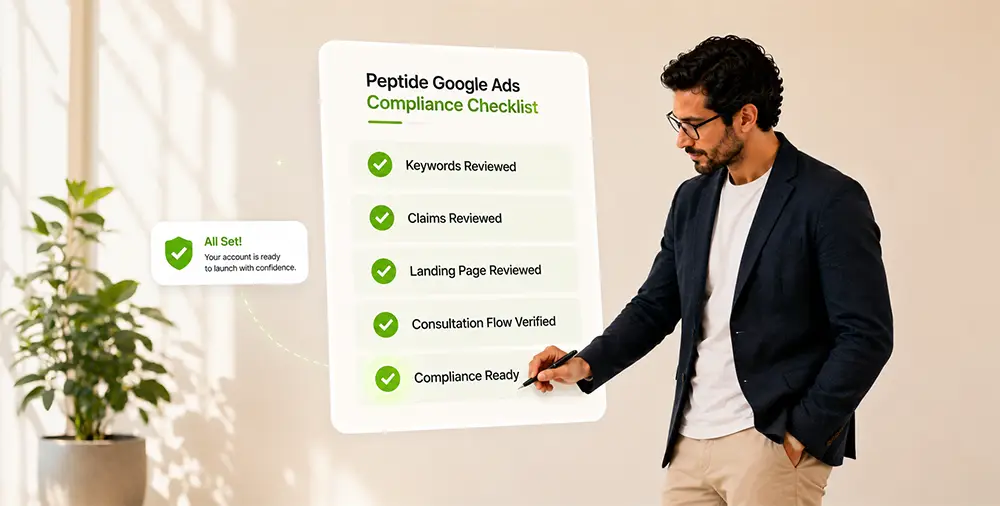
Peptide Google Ads Compliance Checklist
Before launching peptide Google Ads, review the following:
- Define the advertiser type: clinic, telehealth provider, pharmacy, research supplier, agency, or wellness brand.
- Confirm whether Google healthcare certification is required.
- Remove direct product-sale language from clinic campaigns.
- Remove dosing, protocol, injection, and “no prescription” language.
- Avoid disease, injury, fat-loss, anti-aging, and cure claims.
- Build separate campaigns for brand, consultation, education, and B2B compliance intent.
- Add negative keywords before launch.
- Keep landing pages aligned with ad intent.
- Avoid health-sensitive retargeting tactics that Google does not support.
- Document every disapproval, appeal, landing page edit, and approval pattern.
This process will not guarantee approval, but it gives you a cleaner and more defensible campaign.
Final Takeaway
You can advertise peptides on Google, but only if the campaign is built around compliance from the first click.
The safest strategy is to stop selling “peptides” directly in the ad and start advertising the legitimate next step: a physician-supervised consultation, lab-guided wellness evaluation, research-use documentation process, or peptide Google Ads compliance audit.
For LA clinics and wellness brands, the opportunity is real. Search demand exists for peptide therapy Los Angeles, peptide clinic Los Angeles, physician supervised peptide therapy, and longevity clinic Los Angeles. But the brands that win will not be the ones with the loudest claims. They will be the ones with the cleanest offer, the clearest credentials, the safest landing pages, and the strongest compliance discipline.
If you are running peptide Google Ads and the account is already getting disapproved, do not scale spend. Audit the keywords, ad copy, landing page, claims, targeting, certification status, and conversion path first.
That is how you reduce ban risk while still building a campaign that can generate qualified leads.
FAQs
Can peptide clinics run Google Ads?
Yes, but the campaign should usually promote a compliant consultation or eligibility review, not direct peptide sales or treatment claims. The landing page should show provider oversight, accurate credentials, clear disclaimers, and a medically appropriate process.
Can I advertise BPC-157 on Google?
BPC-157-specific advertising is high-risk. Product-specific peptide claims around injury healing, recovery, inflammation, or body performance can trigger healthcare, pharmaceutical, or unapproved-substance policy concerns.
Can I use “research use only” on my peptide landing page?
Only if the entire funnel is genuinely research-focused. FDA has warned that products labeled “for research purposes” or “not for human consumption” can still be problematic when sold directly to consumers with human-use cues or dosing instructions.
What is the safest CTA for peptide Google Ads?
Safer CTAs include “Book a consultation,” “Check eligibility,” “Review the consultation process,” “Request COA documentation,” or “Request a compliance audit.” Avoid “Buy now,” “Start injections,” “Order peptides,” or “No prescription needed.”
Can I retarget peptide website visitors?
Be careful. Health-related content is a sensitive interest category under Google’s personalized advertising rules, and Google lists Customer Match, your data segments, audience expansion, and lookalike segments as not supported for sensitive health categories.
Why did my peptide ads get disapproved?
The most common causes are restricted drug terms, prescription-drug-service signals, unapproved substance claims, unsafe landing page language, direct purchase intent, dosing content, health-sensitive remarketing, or a mismatch between “research use” language and consumer-facing claims.
Does Google healthcare certification guarantee approval?
No. Certification may be required for certain advertisers or keyword targeting, but your ads and landing pages still need to comply with all applicable Google policies, local laws, and industry standards.
What should COLAB offer peptide clinics?
COLAB should offer a peptide Google Ads compliance audit covering keywords, ad copy, landing page claims, negative keywords, certification risk, local LA targeting, and disapproval recovery. The offer should focus on reducing avoidable policy risk, not guaranteeing approval.