Why SEO Still Matters for Immigration Lawyers in an AI-First Search World

AI search did not kill SEO for immigration lawyers. It killed weak SEO.
For years, many law firms treated SEO as a ranking game: publish service pages, add keywords, build backlinks, and hope traffic turns into consultations. That approach is no longer enough. In 2026, immigration lawyer SEO has to do more than help a page rank. It has to prove trust, answer urgent legal questions clearly, support local visibility, and make your firm easier for both people and AI-driven search systems to understand.
That matters because immigration clients are not browsing casually. They may be trying to protect their family, respond to a USCIS notice, prepare for an interview, avoid a scam, fight removal, or understand whether they need legal help before making a mistake. A generic AI summary may explain a broad concept, but it cannot evaluate a person’s documents, history, deadlines, risk factors, or eligibility.
Direct answer: SEO still matters for immigration lawyers in 2026 because AI search systems still depend on crawlable, trusted, useful web content, and clients still need licensed legal professionals for high-stakes immigration decisions. The firms that win will be the ones that combine local SEO, E-E-A-T, answer engine optimization, multilingual content, and strong intake systems.
Google’s own guidance says optimization for generative AI features in Google Search is still SEO. Pages must be indexed and eligible to appear in Search, and Google continues to recommend foundational SEO best practices for AI Overviews and AI Mode.
Search Has Changed, But Client Intent Has Not
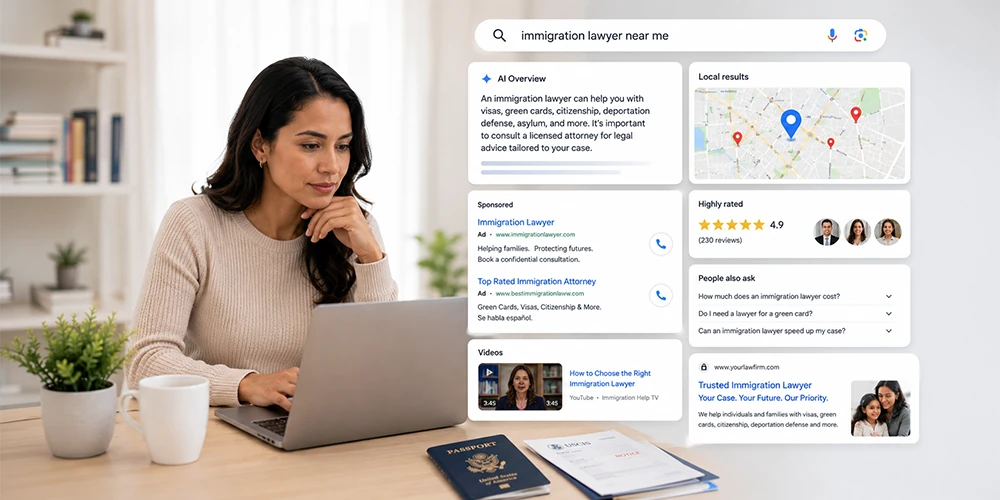
AI-first search has changed the way people move through information. A potential client may now see an AI Overview, a local map pack, attorney ads, review snippets, People Also Ask results, videos, and organic pages before ever clicking a law firm website.
That does not mean your website no longer matters. It means your website has to work harder.
In traditional SEO, a firm could often win by creating a page around a phrase like “green card lawyer Los Angeles” or “immigration attorney near me.” In an AI-first search world, that same page also has to answer related questions:
- What kind of green card case is this?
- What documents are usually involved?
- When should someone talk to a lawyer?
- What mistakes should they avoid?
- Can the firm explain the process in Spanish?
Is the attorney real, licensed, local, and experienced?
This is where AEO for law firms becomes important. AEO, or answer engine optimization, means structuring your content so search engines and AI systems can easily extract clear, accurate answers. But AEO is not a trick. Google has clarified that there are no special requirements or separate AI-only optimizations needed to appear in AI Overviews or AI Mode; the best practices remain grounded in strong SEO, technical clarity, and useful content.
For immigration lawyers, that means the goal is not to “write for AI.” The goal is to write so clearly, credibly, and specifically that your content deserves to be used as a trusted source.
Why Immigration Lawyer SEO Is Different
SEO for immigration lawyers is not the same as SEO for a general local business. Immigration law is high-stakes, emotionally charged, document-heavy, and deeply personal.
A person searching for “deportation defense lawyer near me” is in a very different state of mind than someone searching for “best coffee shop near me.” They may be afraid, confused, embarrassed, or under time pressure. They may not speak English as their first language. They may have already received bad advice from a notario, consultant, friend, or social media account.
That changes the content strategy.
A strong immigration law firm SEO strategy must account for four realities:
First, the client is often problem-aware before they are solution-aware. They may search “what happens after an RFE” before they search “immigration lawyer for RFE response.”
Second, the client may not know which service they need. They might describe the situation instead of the legal category: “my husband was detained by immigration,” “my green card interview went badly,” or “I overstayed my visa and married a U.S. citizen.”
Third, trust is a major conversion factor. Immigration clients need to know whether the attorney is licensed, whether the firm understands their situation, whether the consultation is confidential, and whether the firm can communicate in their language.
Fourth, location still matters. Even though immigration law is federal, clients still search locally. Queries like “immigration lawyer Los Angeles,” “asylum lawyer near me,” and “Spanish-speaking immigration attorney LA” remain valuable because people want accessible, familiar, and responsive legal help.
That is why immigration attorney SEO has to connect three things: visibility, trust, and intake. Traffic alone is not the win. Qualified consultations are the win.
SEO Still Matters Because AI Search Needs Trusted Sources
Some immigration lawyers worry that AI answers will replace organic traffic. That concern is understandable, but incomplete.
AI-generated search results still need source material. Google’s AI features rely on content that can be discovered, indexed, interpreted, and evaluated. If your law firm website is thin, outdated, poorly structured, or hard to crawl, you are less likely to benefit from either traditional SEO or AI-assisted search visibility.
The real shift is this: generic content has less value than before.
A basic article titled “What Is a Green Card?” may not be enough. AI can summarize that. USCIS has official information. Legal directories may already dominate broad definitions. To compete, an immigration law firm should publish content that adds practical, experience-based value:
- What should someone bring to a green card consultation?
- When does a green card case become risky?
- What should someone do if they received a Request for Evidence?
- When should a person avoid filing without legal guidance?
- What should Spanish-speaking families in Los Angeles know before choosing an immigration lawyer?
That kind of content supports both SEO and AEO because it answers real client questions with context, clarity, and legal caution.
Google also recommends creating valuable, non-commodity content for generative AI search rather than simply producing pages that repeat what is already available elsewhere.

E-E-A-T Is the Core of Immigration Lawyer SEO in 2026
E-E-A-T stands for experience, expertise, authoritativeness, and trustworthiness. For immigration lawyers, it is not just an SEO concept. It is the foundation of whether a nervous client believes your firm is safe to contact.
Immigration content affects legal rights, family stability, work authorization, lawful status, and removal risk. That means your website should make it clear who is providing the information, why they are qualified, and what the limits of the information are.
Experience: Show That You Understand Real Immigration Problems
Experience means your content should not sound like it was written by someone who has never spoken to an immigration client.
A page about removal defense should acknowledge urgency, fear, hearing dates, detained loved ones, and the importance of reviewing the person’s immigration history. A page about family-based green cards should explain that every case is different depending on entry history, prior filings, overstays, criminal history, and documentation.
Good experience signals include:
- Attorney-authored or attorney-reviewed content.
- Examples of common client questions.
- Consultation preparation checklists.
- Step-by-step process explanations.
- Clear explanations of what happens next.
- Local insight for USCIS offices, immigration court, or regional client needs.
Avoid vague claims like “we handle all immigration cases.” Be specific enough that the reader feels understood.
Expertise: Make the Legal Authority Visible
Expertise should be visible on every important page.
An immigration law firm website should include attorney bios, bar admission information, practice focus, language capabilities, professional memberships, speaking engagements, publications, and any immigration-specific credentials that are accurate and verifiable.
For SEO, this helps users and search engines understand that the content is connected to a real legal professional. For conversion, it helps the client answer the quiet question: “Can I trust this person with my future?”
Authoritativeness: Build Recognition Beyond Your Own Website
Authoritativeness is not created only by saying “we are experienced.” It is reinforced by third-party signals.
For immigration law firms, authority can come from legal directories, local citations, community organizations, local media mentions, bar associations, immigration resource pages, and high-quality backlinks from relevant sources. This is where traditional SEO still plays a role, but the quality of the signal matters more than the quantity.
A few relevant local or legal links are often more meaningful than dozens of generic directory links.
Trustworthiness: Reduce Fear Before the Client Calls
Trust is the most important part of immigration lawyer marketing.
A strong website should make the next step feel safe. That means clear contact information, accurate office details, transparent consultation expectations, attorney review, privacy-conscious forms, client reviews, language options, and no guaranteed-result language.
It also means publishing protective content. For example, pages explaining how to avoid immigration scams, how to verify an attorney, and the difference between an immigration lawyer and a notario can build significant trust.
This is especially important in California. Los Angeles County warns that dishonest immigration consultants may harm consumers by giving wrong legal advice, claiming special connections, or encouraging people to lie on applications.The State Bar of California also warns that legal-services fraud is becoming more sophisticated, including the use of AI and deepfakes through deceptive websites, social media, texts, and emails.
That is not just a public-service topic. It is a high-trust SEO opportunity most competitors underuse.
Local SEO Still Drives Immigration Law Leads
Even in an AI-first search world, local SEO for immigration lawyers remains one of the most important lead channels.
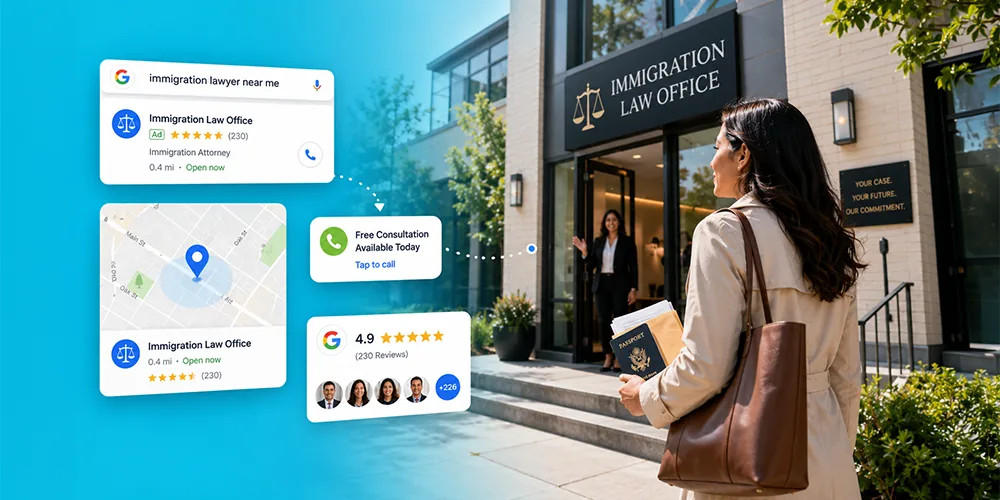
When someone searches “immigration lawyer near me,” “deportation lawyer Los Angeles,” or “abogado de inmigración cerca de mí,” Google is not only evaluating your website. It is also evaluating your Google Business Profile, reviews, proximity, relevance, and prominence.
Google says local ranking is primarily based on relevance, distance, and prominence. It also recommends keeping business information complete and accurate to improve local visibility.
For immigration lawyers, this means your Google Business Profile should not be treated like a basic listing. It should function like a trust and conversion asset.
Your profile should include accurate categories, services, office hours, phone number, website link, appointment link, photos, attorney/team images where appropriate, and service descriptions. The services should match how clients search: green card, family immigration, asylum, naturalization, deportation defense, removal defense, work permits, DACA, VAWA, U visa, waivers, and consular processing.
Reviews also matter. Not because you should pressure clients or script testimonials, but because reviews often answer questions your website cannot answer as convincingly:
- Did the lawyer explain things clearly?
- Did the firm answer quickly?
- Did the client feel respected?
- Was Spanish available?
- Did the firm help with a stressful case?
- Was the process organized?
For immigration lawyer SEO, reviews are both a ranking signal and a trust signal.
AEO for Immigration Lawyers: Structure Content Around Real Questions
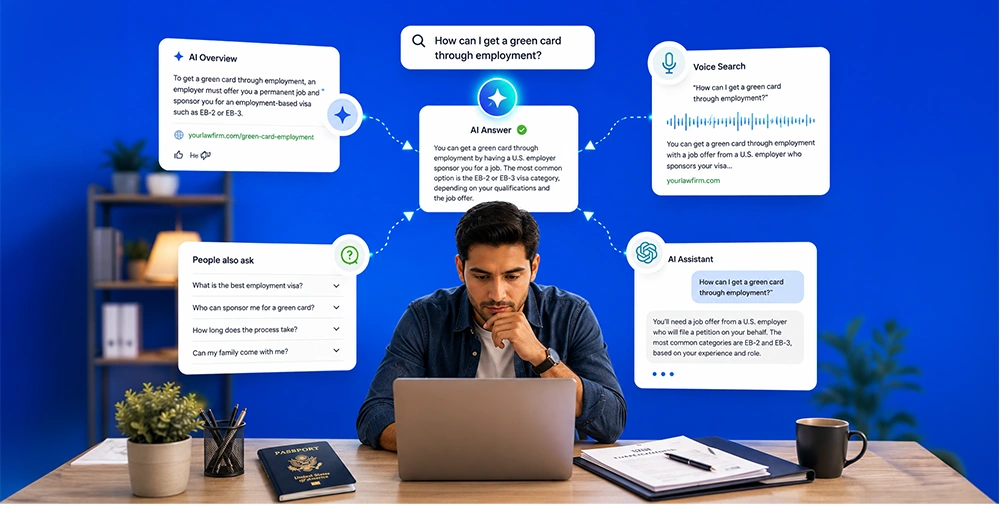
AEO optimization is not about stuffing FAQs at the bottom of a page. It is about building pages that answer questions clearly at the exact moment a searcher needs help.
Every major immigration SEO page should include concise answer sections near the top.
For example:
Do I need an immigration lawyer for a green card case?
Not every green card case requires a lawyer, but legal help may be important if there are prior immigration violations, criminal history, past denials, inadmissibility concerns, missing documents, or complicated family/employment facts.
Can AI answer immigration legal questions?
AI can provide general information, but it cannot safely evaluate a person’s full immigration history, documents, deadlines, risks, or eligibility. Immigration decisions should be reviewed with a licensed legal professional.
What is local SEO for immigration lawyers?
Local SEO helps immigration law firms appear in Google Maps, local search results, and location-based queries such as “immigration lawyer near me” or “Spanish-speaking immigration lawyer Los Angeles.”
These direct answers help both users and search systems. The key is to follow each answer with useful detail, not generic filler.
AEO-friendly immigration content should use clear headings, short answer blocks, attorney-reviewed explanations, internal links, schema where appropriate, and natural language queries. It should also avoid overclaiming. Immigration law is too sensitive for absolute promises.

The Content Strategy Immigration Lawyers Need in 2026
A strong immigration law firm SEO strategy should not be built around random blog posts. It should be built around client journeys.
Start with practice-area pages. These are the commercial pages that target high-intent searches:
- Green card lawyer
- Family immigration lawyer
- Asylum lawyer
- Deportation defense lawyer
- Removal defense lawyer
- Naturalization lawyer
- Work permit lawyer
- Immigration waiver lawyer
- DACA lawyer
- VAWA lawyer
- U visa lawyer
- Consular processing lawyer
Each page should answer who the service is for, when legal help is important, what the process may involve, what documents may be needed, what risks exist, and how to schedule a consultation.
Then build problem-aware content around the questions clients ask before they know what service they need:
- What happens after a USCIS Request for Evidence?
- Can I apply for a green card after overstaying a visa?
- What should I do if I missed an immigration court hearing?
- Can I become a citizen with a criminal record?
- What happens if my spouse refuses to help with my case?
- What should I bring to an immigration consultation?
- How do I know if an immigration lawyer is licensed?
Finally, build trust and safety content. This is where many competitors are thin.
Write pages like:
- How to verify an immigration lawyer in California.
- Immigration lawyer vs notario: what is the difference?
- How to avoid immigration scams in Los Angeles.
- What an immigration lawyer can and cannot guarantee.
- Questions to ask before hiring an immigration attorney.
- What to expect during a confidential immigration consultation.
This type of content supports E-E-A-T, helps vulnerable searchers, and differentiates the firm from generic SEO competitors.
Los Angeles Immigration Lawyer SEO Requires Local and Multilingual Depth
Los Angeles immigration lawyer SEO needs a more localized approach than a national SEO campaign.
LA is multilingual, competitive, and highly community-driven. A law firm that wants to rank and convert in this market should not rely only on English service pages. It should build content around language, neighborhood, urgency, and trust.
Spanish-speaking immigration lawyer SEO is especially important, but the strategy should not be limited to direct translation. Spanish-speaking users may search differently, ask different questions, and respond to different trust signals.
Examples include:
- abogado de inmigración Los Angeles
- abogado de deportación Los Angeles
- abogado para residencia en Los Angeles
- abogado para asilo en Los Angeles
- consulta con abogado de inmigración
- cómo evitar fraude migratorio
- notario vs abogado de inmigración
A Spanish page should not simply mirror the English page word for word. It should be written for the client’s search behavior, fear level, and decision process.
Local pages should also avoid doorway-page SEO. A thin page for every LA neighborhood with the same copy will dilute quality. A useful local page should include who the page helps, which immigration issues are relevant, how consultations work, language availability, office or service-area context, attorney trust signals, and links to helpful local resources.
For LA firms, strong local content may include:
- What to do if a loved one is detained by immigration in Los Angeles.
- How to choose a Spanish-speaking immigration lawyer in LA.
- How to avoid notario fraud in Los Angeles.
- What to bring to an immigration consultation in Los Angeles.
- How to prepare for a USCIS interview with legal guidance.
This is where immigration lawyer marketing becomes more than visibility. It becomes reassurance.
How COLAB LAX Helps Immigration Lawyers Compete in Los Angeles Search
For immigration law firms in Los Angeles, visibility is only valuable when it turns into qualified consultations. Ranking for terms like immigration lawyer Los Angeles, Spanish-speaking immigration attorney, or deportation defense lawyer near me requires more than publishing pages with keywords. It requires a strategy that connects local search intent, attorney trust signals, multilingual content, Google Business Profile optimization, and conversion-focused web design.
This is where COLAB LAX can support immigration lawyers with a more complete approach to digital growth. COLAB Los Angeles is a local digital marketing agency offering services such as SEO, PPC, branding, web design, and video production, which makes it well-positioned to help law firms build visibility across both organic search and paid channels.
For immigration attorney SEO, the goal is not just to increase traffic. The goal is to help the right people find clear answers, trust the firm, and take the next step. That means building practice-area pages for high-intent services, creating helpful content around real immigration questions, improving local SEO signals, strengthening E-E-A-T, and making the consultation path simple on every page.
COLAB LAX can help immigration law firms create a search presence that feels local, credible, and easy to act on. From SEO content and Google Business Profile strategy to landing pages, paid ads, and video assets, the focus should be on helping potential clients understand who the firm serves, what problems it handles, and why reaching out is the safest next step.
For firms competing in a crowded Los Angeles legal market, this kind of SEO is not about chasing rankings alone. It is about building a stronger digital intake system that helps immigration clients find trusted legal help when they need it most.
Technical SEO Still Matters Because AI Cannot Use What It Cannot Access
Technical SEO may sound less exciting than AI, but it remains foundational.
If your site is not crawlable, indexable, fast, mobile-friendly, and logically structured, your content is less likely to perform in traditional search or AI-assisted search. Google’s AI guidance specifically ties eligibility to pages being indexed and eligible to show a snippet in Search.
For immigration law firms, technical SEO should focus on practical client access:
- Fast mobile pages.
- Clear call buttons.
- Clickable phone numbers.
- Simple consultation forms.
- Language switch options.
- Secure browsing.
- Readable page design.
- Attorney bio links.
- Internal links between related services.
- Schema for attorney, local business, FAQ, breadcrumbs, and organization where accurate.
Internal linking should follow the way a client thinks.
For example, a blog post about overstaying a visa might link to a green card lawyer page, a waiver page, an attorney bio, and a consultation page. A page about ICE detention might link to deportation defense, bond hearings, family resources, and emergency consultation options.
The goal is to help users and search engines understand the relationship between problems, services, attorneys, and next steps.
What to Avoid: Fluff That Dilutes Immigration SEO
Content dilution is one of the biggest reasons law firm blogs underperform.
Avoid long sections explaining “what is SEO” in generic terms. Your reader does not need a marketing textbook. They need to understand why SEO still matters for immigration lawyers now.
Avoid generic claims like “content is king,” “backlinks are important,” or “AI is changing everything” unless the section explains exactly what that means for immigration law firms.
Avoid thin city pages. If the only difference between pages is the city name, the content is not useful enough.
Avoid keyword stuffing. Repeating “SEO for immigration lawyers” unnaturally will make the content worse, not stronger.
Avoid legal overpromising. Do not say or imply that hiring a lawyer guarantees approval, stops deportation, or ensures a specific immigration outcome.
Avoid AI gimmicks. Google has stated that there are no special AI Overview requirements or special optimizations necessary beyond sound SEO best practices.
Avoid publishing AI-generated legal content without attorney review. Google warns that generative AI may be useful for research and structure, but scaled AI content without added value may violate spam policies. For legal content, the reputational risk is even higher.
The best immigration attorney SEO content is specific, useful, reviewed, local, and trust-building.
How to Measure SEO Success in 2026
Rankings still matter, but they are not the only metric.
An immigration law firm should measure SEO by how well it creates qualified consultations and signed cases. That requires connecting search visibility to intake data.
Track:
- Organic calls.
- Form submissions.
- Consultation bookings.
- Google Business Profile calls.
- Direction requests.
- Local pack visibility.
- Spanish-page conversions.
- Practice-area page conversions.
- Qualified case types.
- Signed cases from organic search.
- AI Overview visibility where trackable.
- Branded search growth.
Also track the quality of leads. A page that generates fewer visitors but more retained cases is more valuable than a blog post that attracts broad informational traffic with no commercial intent.
This is where many immigration law firm SEO campaigns fail. They report traffic but do not connect that traffic to intake, consultations, or revenue.
The better question is not “How many people visited the website?” The better question is: “Which pages helped qualified immigration clients contact the firm?”
The Future of Immigration Lawyer SEO Is Trust-Led
In 2026, the best SEO for immigration lawyers will not come from publishing more generic content. It will come from becoming the most trusted, helpful, locally relevant source for the cases your firm actually wants.
AI search will keep changing. Google results will keep evolving. Competitors will keep publishing basic SEO pages about keywords, backlinks, and reviews.
But the underlying client need will remain the same.
People facing immigration problems want clarity. They want safety. They want someone who understands the law, speaks plainly, respects their situation, and can explain what to do next.
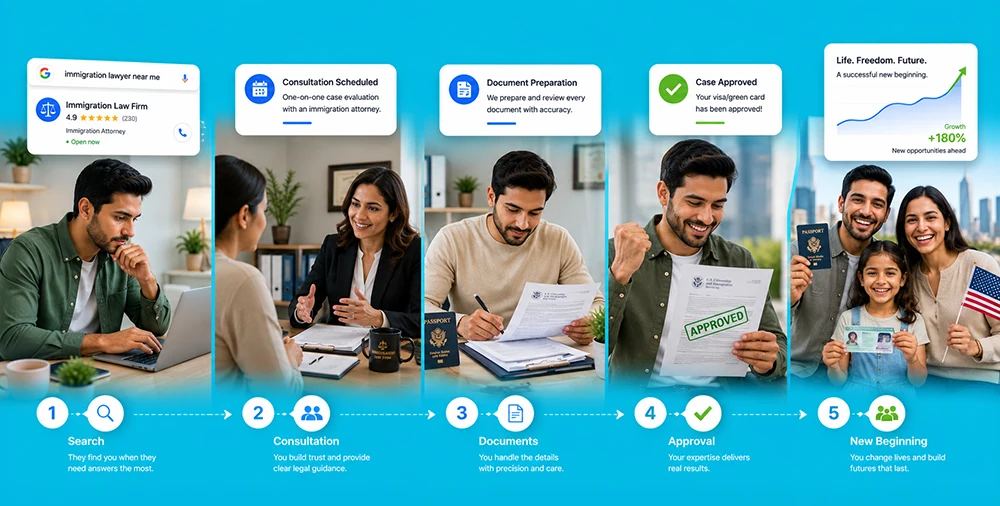
That is why SEO still matters. It helps your firm show up at the moment a person is searching for help. E-E-A-T helps them believe you. AEO helps your answers get found. Local SEO helps nearby clients contact you. Multilingual content helps more people understand you. Strong intake turns that visibility into real consultations.
AI-first search does not make immigration lawyer SEO less important. It makes trustworthy immigration lawyer SEO more important than ever.
FAQs
Does SEO still work for immigration lawyers in 2026?
Yes. SEO still works for immigration lawyers, but the strategy has changed. Firms now need more than keyword-optimized pages. They need attorney-reviewed content, strong local SEO, Google Business Profile optimization, reviews, multilingual content, and answer-focused pages that support both traditional search and AI search.
How does AI search affect immigration lawyer SEO?
AI search affects immigration lawyer SEO by answering some basic questions directly in search results. This makes generic content less valuable. To compete, immigration law firms should publish specific, trustworthy, experience-based content that answers real client questions and shows clear legal authority.
What is AEO for immigration lawyers?
AEO, or answer engine optimization, means structuring content so search engines and AI systems can easily understand and summarize it. For immigration lawyers, this includes clear question-based headings, concise answers, FAQs, attorney-reviewed explanations, and pages built around real immigration problems.
Is local SEO important for immigration lawyers?
Yes. Local SEO is critical because many immigration clients search for nearby legal help using queries like “immigration lawyer near me,” “deportation lawyer Los Angeles,” or “Spanish-speaking immigration attorney.” Google’s local results are influenced by relevance, distance, and prominence.
What content should immigration lawyers publish first?
Start with high-intent practice-area pages, then build supporting content around common client problems. Important pages include green card lawyer, asylum lawyer, deportation defense lawyer, naturalization lawyer, family immigration lawyer, work permit lawyer, and immigration waiver lawyer. Then add trust-building pages about attorney verification, notario fraud, consultation preparation, and immigration scams.
Should immigration law firms create Spanish-language SEO pages?
Yes, especially in markets like Los Angeles. Spanish-language immigration SEO should not be a direct translation of English pages. It should reflect how Spanish-speaking clients actually search, what concerns they have, and what information they need before contacting a lawyer.
Can AI replace an immigration lawyer?
No. AI can provide general information, but it cannot safely evaluate a person’s complete immigration history, documents, risks, deadlines, or eligibility. Immigration decisions can affect legal status, family unity, employment, and removal risk, so people should speak with a licensed legal professional for case-specific guidance.
What makes immigration law content trustworthy?
Trustworthy immigration law content is accurate, attorney-reviewed, clearly sourced, locally relevant, easy to understand, and careful not to promise outcomes. It should identify the attorney or firm behind the information and make clear that the content is informational, not legal advice.
How should immigration lawyers measure SEO ROI?
Immigration lawyers should measure SEO ROI by tracking qualified consultations, signed cases, organic calls, form submissions, Google Business Profile actions, local rankings, practice-area conversions, and Spanish-page performance. Traffic alone is not enough.
What is the biggest SEO mistake immigration lawyers make?
The biggest mistake is publishing generic content that does not build trust or match real client intent. In 2026, immigration lawyer SEO should focus on specific legal problems, local relevance, multilingual accessibility, E-E-A-T, and conversion-ready intake pathways.