Local SEO for Personal Injury Lawyers: The Best Marketing & Advertising Strategies

When someone searches “personal injury lawyer near me” at 11 PM from a hospital waiting room, your firm either shows up or it does not. Local SEO for personal injury lawyers is the strategy that makes sure your firm appears at that exact moment, in Google Maps, the local pack, and organic results, before a competitor takes the call.
This guide covers every high‑impact element of SEO for personal injury lawyers in 2026: Google Business Profile optimization, topical authority building, AEO‑ready content structure, technical SEO, E‑E‑A‑T signals, review strategy, and conversion tracking.
Quick Answer: Is Local SEO Worth It for Personal Injury Lawyers?
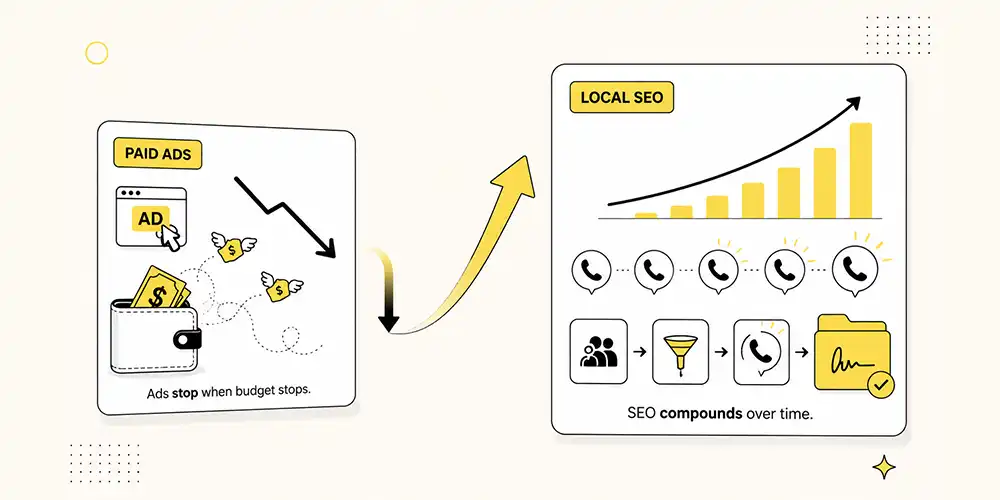
Yes. SEO for personal injury lawyers delivers one of the highest returns in legal marketing because it captures high‑intent searches at the exact moment a potential client needs help. Unlike paid ads that stop when your budget runs out, a strong local SEO foundation compounds over time.
A well‑executed personal injury law firm SEO strategy helps your firm:
- Appear in Google Maps and the local 3‑pack for city and practice‑area searches
- Rank for high‑converting terms like “car accident lawyer [city]” and “personal injury attorney near me”
- Build trust through reviews, credentials, and attorney‑reviewed content
- Generate qualified consultation calls without paying per click
- Reduce long‑term dependence on paid lead generation
- Become the obvious, credible choice for injured people searching in your market
Why SEO for Personal Injury Lawyers Is Different
Personal injury attorney SEO operates differently from other practice areas because the search intent is urgent and highly local. A person searching for a personal injury lawyer is not browsing; they are in pain, dealing with insurance companies, and looking for someone they can trust right now.
This urgency changes how SEO must be built. It is not enough to rank for broad legal terms; your firm must appear in the right location, for the right case type, and with enough proof of credibility to trigger a call. Google’s local ranking algorithm weighs relevance, distance, and prominence together, so your profile, your website, and your reputation all need to work in sync.
Personal injury is also one of the most competitive verticals in legal SEO. You are not just competing with other local firms. You are competing with:
- Large multi‑location injury firms with seven‑figure SEO budgets
- Legal directories like Avvo, FindLaw, and Justia
- Lead generation companies buying top placements
- AI Overviews and answer‑engine results that reduce click‑through rates
- Local Services Ads occupying the top of the page
To win in this environment, your SEO strategy for personal injury lawyers must be built on four pillars: local relevance, topical authority, E‑E‑A‑T proof, and conversion clarity.
The Local SEO Ranking Factors That Matter Most
Google does not rank personal injury law firms on a single signal. Local visibility in 2026 is the result of several interconnected ranking factors working together.
1. Google Business Profile relevance
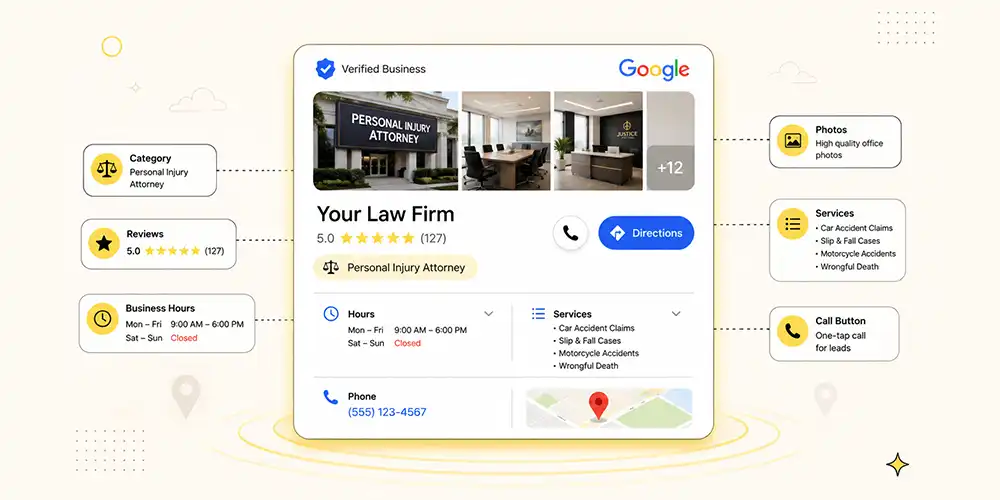
Your Google Business Profile (GBP) is often the first thing a potential client sees, before your website, before your reviews page, and before any ad. For personal injury law firm SEO, your GBP must clearly communicate your practice areas, location, and trustworthiness.
An optimized GBP for personal injury attorneys should include:
- Primary category set to “Personal Injury Attorney”
- Services listing all major case types (car accidents, truck accidents, slip and fall, wrongful death, etc.)
- Accurate NAP (Name, Address, Phone) consistent with your website
- Business hours, holiday hours, and consultation booking link
- A keyword‑informed business description written for real clients
- Attorney headshots, office photos, and short introduction videos
- Consistent review responses that reflect compassion and professionalism
Avoid category stuffing. Adding irrelevant secondary categories dilutes your GBP relevance signal and can confuse both Google and potential clients.
2. Proximity and honest location strategy
Google uses physical distance as a ranking input, especially for mobile searches. This does not mean creating fake addresses or duplicate listings, both can result in profile suspension. It means building an honest location strategy:
- Keep your office address accurate and verified
- Define clear service areas in your GBP
- Build legitimate location pages only where your firm genuinely serves clients
- Use location‑specific content that references real local context (courts, hospitals, intersections, local statutes)
- Maintain consistent citations across all directories

3. Review quality and recency
Reviews influence both rankings and conversion. In a competitive local market, a potential client comparing three firms in the local pack will almost always call the firm with stronger, more recent, and more detailed reviews first.
The most persuasive reviews for personal injury attorneys mention:
- Responsiveness after the initial call
- Clear communication throughout the case
- Compassion during a stressful situation
- Guidance on dealing with insurance companies
- Specific case types (car accident, slip and fall, etc.)
A review that says “great lawyer” is weak. A review that says “they called me back the same day after my car accident and walked me through exactly what to say, and not say, to the insurance adjuster” is a conversion asset.
Regulatory note: the FTC’s Consumer Reviews and Testimonials Rule (effective October 2024) prohibits fake, incentivized, or deceptive reviews. Any personal injury law firm SEO strategy must keep review generation fully compliant.
4. Website topical authority
Google needs evidence that your site is a comprehensive, authoritative resource on personal injury law, not just a thin service page with your phone number. Topical authority comes from depth and logical coverage, not from publishing volume alone.
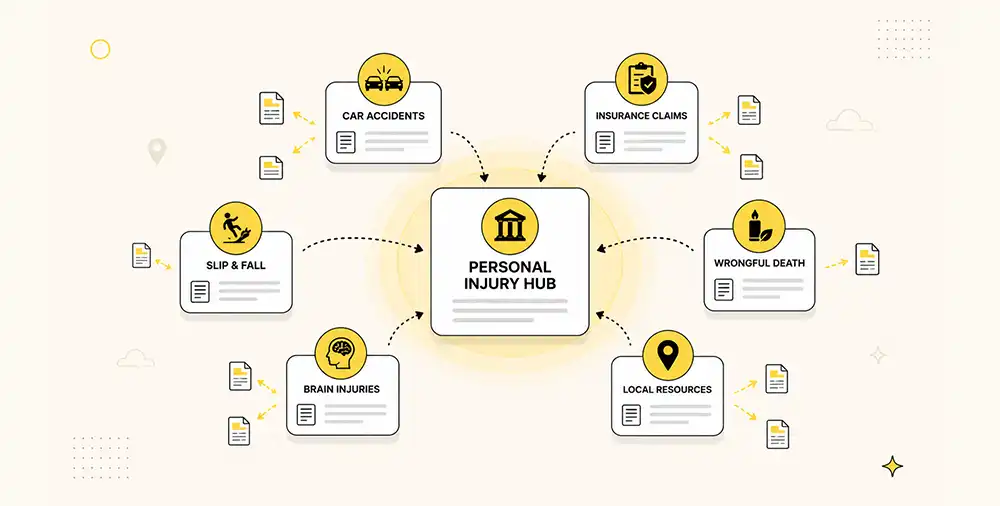
A strong personal injury law firm SEO content structure includes:
- A pillar page for personal injury
- Practice‑area pages for every case type you handle
- Location‑specific pages with genuine local value
- FAQ and informational content that answers real pre‑consultation questions
- Injury‑specific pages (brain injuries, spinal cord injuries, soft tissue injuries)
- Insurance claim guides and process explainers
5. E‑E‑A‑T signals for legal content
Legal content sits in Google’s “Your Money or Your Life” category, which means it is held to a higher standard for experience, expertise, authoritativeness, and trust. For search engine optimization for personal injury lawyers, E‑E‑A‑T is not optional; it is foundational.
Your site should demonstrate:
- Named attorneys as authors or reviewers on every content piece
- Verified bar admissions and license credentials
- Attorney bios with case experience and professional history
- Clear ethical disclaimers and fee transparency
- Updated content with accurate legal information
- Real client reviews with compliant responses
- Visible contact information on every page
How to Optimize Google Business Profile for Personal Injury Lawyers
Your GBP is your most important local ranking asset. It appears above your website in Maps and local pack results, especially on mobile, where most injury‑related searches happen.
A complete, optimized profile should include the essentials (name, address, phone, website, hours) plus well‑structured services and visual proof that your firm is real and local.
Services to add to your GBP:
- Car accident lawyer
- Truck accident lawyer
- Motorcycle accident lawyer
- Pedestrian accident lawyer
- Bicycle accident lawyer
- Slip and fall lawyer
- Dog bite lawyer
- Wrongful death lawyer
- Brain injury lawyer
- Spinal cord injury lawyer
- Rideshare accident lawyer (Uber/Lyft)
- Premises liability lawyer
- Catastrophic injury lawyer
Each service should have a client‑facing description that answers “what does this mean for me?” rather than relying on legal jargon. Use real photos of your office, attorneys, and team, stock images weaken the trust your profile needs to convert.
Build Topical Authority With the Right Content Clusters
Topical authority is how your site tells Google: “This is the definitive resource on personal injury law in this city.” It is built by covering a subject comprehensively, not by stuffing keywords into a single page. For personal injury lawyer SEO services, this means organizing your content into intentional clusters.
Core personal injury cluster
Start with the foundational questions every potential client asks:
- What is a personal injury claim?
- Do I have a personal injury case?
- How long do I have to file? (statute of limitations by state)
- How much is my injury case worth?
- What damages can I recover?
- How long does a personal injury case take?
- What happens during a free consultation?
Car accident content cluster
Car accident searches drive the highest volume of personal injury leads. Build content around:
- What to do immediately after a car accident
- When to call a car accident lawyer (vs. handling it yourself)
- Delayed pain and injury symptoms after a crash
- What to do if the other driver is uninsured
- How fault and comparative negligence are determined
- How medical bills are paid after a car accident
- Common car accident injuries and their long‑term impact
Insurance claim content cluster
Insurance content has high intent and is often under‑served on law firm sites. Cover:
- What to do when the insurance adjuster calls
- Why you should not give a recorded statement without a lawyer
- How insurance companies calculate settlement offers
- Claim denial and underpayment tactics
- Uninsured and underinsured motorist claims
- Policy limits and what happens when they are not enough
Injury‑specific content cluster
Build standalone pages or substantial sections for:
- Traumatic brain injuries (TBI)
- Spinal cord injuries
- Herniated and bulging discs
- Broken bones and fractures
- Soft tissue injuries
- Burns and scarring
- Wrongful death claims
Local process content cluster
This is the content most law firms skip, and exactly where you can differentiate. Create content around:
- How to get an accident report in [city]
- Dangerous intersections and high‑crash corridors in [city]
- Local hospital resources after serious accidents
- The personal injury claims process in [state]
- [State] statute of limitations explained
- Local court procedures for injury lawsuits
This level of local specificity builds the relevance signal that generic legal content can never replicate.
AEO: How to Optimize for Answer Engines and AI Search
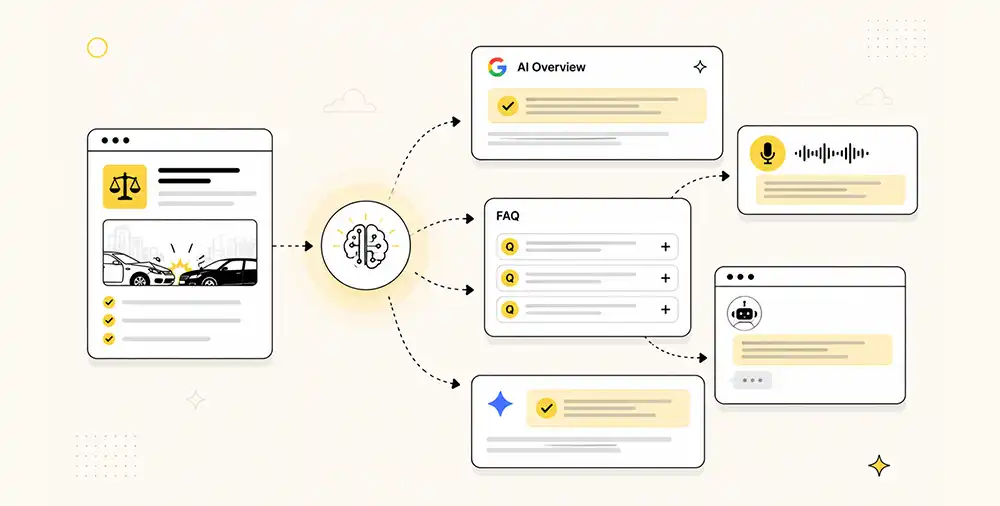
Answer Engine Optimization (AEO) has become essential because AI Overviews, Google’s generative experiences, and voice search now answer user questions directly, often without a click. If your content is not structured for these systems, you lose visibility even when you rank.
AEO does not mean writing robotic FAQ pages. It means making your content easy for both humans and AI systems to parse, trust, and surface.
For personal injury SEO, this means:
- Leading key sections with a short, direct answer block
- Using H2 and H3 headings that mirror real search queries
- Building FAQ sections with attorney‑reviewed answers
- Including step‑by‑step explanations for process‑driven topics
- Using definition‑style openings for term‑based queries
- Implementing FAQ schema where appropriate
- Keeping content updated and clearly attributed to attorneys
How much does a personal injury lawyer cost?
Most personal injury lawyers work on a contingency fee basis. Clients typically pay no attorney fees upfront. The lawyer is paid a percentage of the settlement or verdict if the case is won. The exact percentage varies by firm and case type, so it should be discussed during the free consultation.
Multiply this structure across FAQ and service pages, and your personal injury attorney SEO content becomes AI‑ready at scale.
Technical SEO for Personal Injury Law Firm Websites
Technical SEO is the infrastructure that makes everything else work. Even excellent content will underperform if your site has crawl issues, slow mobile load times, or broken internal links. For SEO for personal injury law firms, the essentials include:
- Fast mobile page speed (Core Web Vitals passing)
- HTTPS secure connection across all pages
- Clean, descriptive URL structure (for example, /car-accident-lawyer-los-angeles/)
- XML sitemap submitted in Google Search Console
- Logical internal linking between practice‑area pages and related content
- Optimized title tags and meta descriptions using primary keywords
- Image alt text that accurately describes attorneys, offices, and case types
- No duplicate thin city pages that dilute site authority
- Clear conversion paths on every high‑intent page
Mobile performance deserves special emphasis. Most personal injury searches happen on smartphones, often in high‑stress moments like after an accident or from a hospital. Your mobile experience must make it easy to call, fill out a form, or read reviews. A slow or confusing mobile site costs signed cases.
Schema Markup for Personal Injury Lawyer SEO
Schema markup is structured data that helps search engines understand exactly what each page is about. For personal injury lawyer SEO, the right schema types improve how your content appears in search results and increase eligibility for rich results.
Recommended schema types for personal injury firms include:
- LegalService for service and practice‑area pages
- LocalBusiness for your main location page
- Attorney or Person for attorney bio pages
- FAQPage for true FAQ sections
- BreadcrumbList for navigation
- Article or BlogPosting for blog content with attorney review
- VideoObject for attorney introduction or explainer videos
- Review markup only where compliant with Google’s review policies
Schema must always reflect visible on‑page content. Marking up content that does not exist violates structured data guidelines and can lead to manual actions
Local Citations and Link Building for Personal Injury Attorneys
Prominence, one of Google’s three core local ranking factors, is built through your firm’s presence across the web. Citations (mentions of your name, address, and phone number) and local links both contribute to how prominent Google considers your firm to be.
High‑priority citation sources for personal injury firms include:
- Google Business Profile
- Avvo
- Justia
- FindLaw
- Super Lawyers
- Martindale
- Yelp
- Bing Places
- State bar profile
- Local bar association listing
- Apple Maps
Beyond citations, local link building for personal injury firms focuses on earning mentions from sources that reinforce location, credibility, and practice area:
- Local news features on accident statistics or legal commentary
- Community sponsorships and charity partnerships
- Safety awareness campaigns
- Local bar association events and committees
- Scholarship programs (law school or community‑focused)
- Local podcast and radio appearances as a legal expert
- Expert commentary on local news or broadcast media
The goal is not volume; it is relevance and authority.
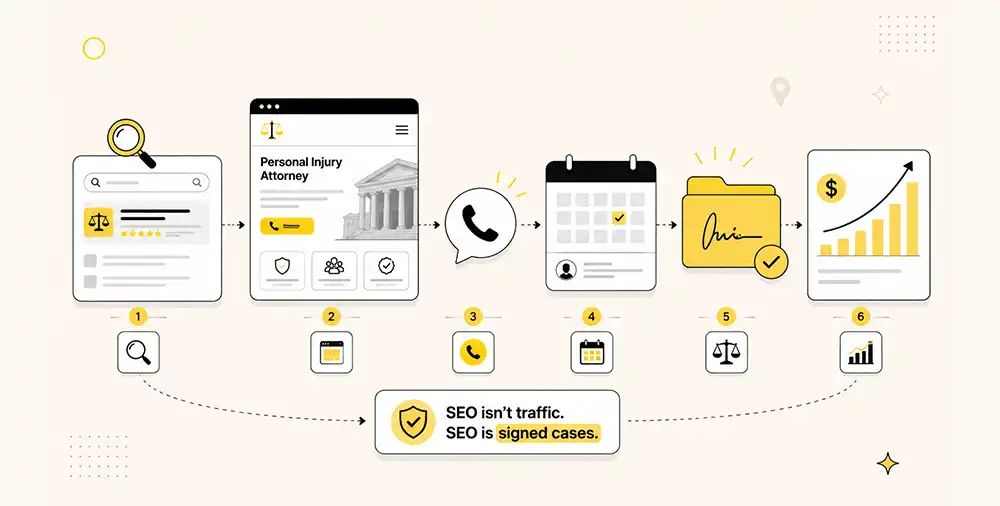
Conversion: Turning Local SEO Traffic Into Signed Cases
Traffic without conversion is noise. Every high‑intent page on your site should be designed to answer the five questions a potential client silently asks when they land:
- Do you handle my type of case?
- Do you serve my area?
- Can I reach someone soon?
- Do I have to pay upfront?
- Can I trust you?
High‑converting page elements for personal injury firms include:
- Click‑to‑call phone number above the fold on mobile
- Short, simple consultation form (name, phone, contact preference, brief case description)
- Clear contingency fee message such as “No fee unless we win” (if accurate for your firm)
- Attorney headshots with clear credentials and bar admissions
- Review snippets from real clients and links to full reviews
- Case results where ethically permissible in your jurisdiction
- Trust indicators such as bar memberships, awards, and years of experience
- A short “what happens after you contact us” explanation near the primary CTA
The intake process itself is part of your SEO investment. A missed call or a two‑day callback delay wastes every dollar you put into rankings.
What Personal Injury Law Firms Should Track
Rankings and traffic are inputs, not outcomes. Personal injury law firm marketing that drives real ROI is tracked at the business‑result level, not just the keyword level.
Track these metrics by source and landing page:
- Google Business Profile calls (separate from website calls)
- Organic website calls via call tracking software
- Contact form submissions
- Live chat and SMS leads
- Consultation requests booked
- Qualified leads (cases that meet intake criteria)
- Signed cases by case type
- Cost per signed case
- Intake response time and missed call rate
This data reveals which keywords, pages, and channels produce signed cases, not just sessions. A truck accident page may get fewer visits than a general blog article but produce cases worth ten times more.
Common SEO Mistakes Personal Injury Lawyers Should Avoid
Even firms with significant SEO budgets make avoidable mistakes that limit their results. Here are the most common pitfalls in personal injury attorney SEO:
Mistake 1: Publishing generic legal content
Content like “5 reasons to hire a personal injury lawyer” does not build authority. Replace thin topics with specific, question‑driven content, such as “What if my pain started two days after the accident?” or “Should I accept the insurance company’s first offer?”
Mistake 2: Creating duplicate city pages
Dozens of near‑identical pages that only swap city names signal low‑quality content. Each location page must offer unique, locally relevant value.
Mistake 3: Ignoring attorney E‑E‑A‑T
Anonymous legal content is a liability in 2026. Every substantive page should name an attorney, author or reviewer with verifiable credentials.
Mistake 4: Using AI content without legal review
AI tools can accelerate content production, but every legal claim must be reviewed by a qualified attorney before publication. Inaccurate legal information creates both SEO risk and professional liability.
Mistake 5: Measuring traffic instead of cases
Ranking first for a low‑intent keyword that never generates consultations is not a win. Tie every SEO metric back to signed‑case outcomes.
Mistake 6: Neglecting intake
No SEO strategy can overcome a poor intake process. Missed calls, slow responses, and unclear follow‑up lose clients you have already paid to attract.
Local SEO Checklist for Personal Injury Lawyers
Use this checklist to audit your firm’s current local SEO foundation.
Google Business Profile
- Verified and active profile
- Primary category set to Personal Injury Attorney
- All services listed with client‑facing descriptions
- Accurate NAP matching website and directories
- Hours updated, including holidays
- Real office, attorney, and team photos
- Review requests built into intake process
- All reviews responded to professionally
- Q&A section monitored and answered
Website SEO
- Comprehensive personal injury pillar page
- Individual pages for each case type
- Location pages with genuine local value (not just city‑name swaps)
- Optimized title tags with primary keywords
- Meta descriptions on all key pages
- Fast mobile load speed with good Core Web Vitals
- Schema markup implemented (LegalService, FAQPage, Attorney, LocalBusiness where appropriate)
- Clean, descriptive URL structure
- Strong internal linking between related pages
E‑E‑A‑T
- Attorney bios with bar admissions and case experience
- Attorney name on all substantive content pages as author or reviewer
- Ethical disclaimers and no‑guarantee language where necessary
- Transparent contingency fee information
- Updated content with accurate legal information
- Visible contact details on every page
Content Authority
- Robust personal injury FAQ section
- Car accident content cluster published
- Insurance claim content cluster published
- Injury‑specific pages (TBI, spinal cord, etc.)
- Local process content (statutes, courts, accident reports, local resources)
- AEO‑formatted answer blocks on key pages
Conversion and tracking
- Call tracking implemented by source
- GBP calls tracked separately from website calls
- Form submissions attributed to landing page
- Consultations and signed cases tracked by source and case type
- Intake response time monitored
- Missed calls flagged and followed up
How COLAB LAX Helps Personal Injury Lawyers Improve Local SEO
For personal injury law firms in Los Angeles, local SEO is not just about ranking higher. It is about being found when injured people are ready to call. COLAB LAX helps law firms strengthen their local search presence through Google Business Profile optimization, SEO-focused website improvements, AEO-ready content, local landing pages, and conversion-focused strategy.
A strong campaign should help your firm appear for searches like personal injury lawyer near me, car accident lawyer Los Angeles, and personal injury attorney SEO while also building trust through reviews, attorney credibility, clear service pages, and easy contact options.
With the right local SEO strategy, COLAB LAX can help personal injury law firms attract better-quality leads, improve online visibility, and turn high-intent search traffic into consultation opportunities.
Final Takeaway: Local SEO Builds Trust, Not Just Rankings
Local SEO for personal injury lawyers works best when your entire online presence tells a consistent story: your firm is local, credible, compassionate, and easy to reach. Rankings open the door, but trust is what turns a search into a signed case.
In 2026, winning SEO for personal injury lawyers requires an integrated approach: an optimized Google Business Profile, deep topical authority, attorney‑backed E‑E‑A‑T signals, AEO‑structured content, clean technical SEO, and a conversion‑focused website that makes it easy for someone to contact you at 11 PM from a hospital waiting room.
The firms that dominate local search are not always the ones with the biggest budgets. They are the ones with the clearest strategy, the strongest proof, and the best experience at every touchpoint from search to signed case.
FAQs
What is local SEO for personal injury lawyers?
Local SEO for personal injury lawyers is the process of optimizing a law firm’s online presence, GBP, website, reviews, and citations, so the firm appears in local search results when injured people in its service area look for legal help.
How long does SEO take for personal injury law firms?
Most personal injury firms see meaningful ranking improvements within four to six months of consistent SEO work. Highly competitive markets such as Los Angeles, New York, or Chicago may require nine to eighteen months for significant local‑pack movement. SEO for personal injury lawyers functions as a long‑term growth channel, not a quick fix.
What are the most important personal injury lawyer keywords?
The highest‑value personal injury lawyer keywords combine practice area and location intent. Examples include “car accident lawyer [city],” “personal injury lawyer near me,” “personal injury attorney [city],” and “truck accident lawyer [city].” Long‑tail keywords like “what to do after a car accident in [city]” support topical authority and capture pre‑consultation searches.
Does Google Business Profile help personal injury lawyers get more cases?
Yes. An optimized GBP helps your firm appear in the Google Maps 3‑pack, which often receives more clicks than top organic results on mobile. It also surfaces reviews, office photos, and a direct call button in search results, reducing friction between search and contact.
What is AEO and why does it matter for personal injury SEO?
AEO, or Answer Engine Optimization, is the practice of structuring content so search engines and AI systems can extract, summarize, and surface answers directly in search results. For personal injury lawyers, AEO means using clear headings, short answer blocks, FAQ schema, and attorney‑reviewed content that AI Overviews and voice search can confidently cite.
Should personal injury firms create city‑specific pages?
Yes, but only when the pages are genuinely useful. A strong city page includes local accident context, relevant statutes, nearby courts and hospitals, specific case‑type information, and attorney credentials for that market. Thin pages that only swap city names dilute site authority and can trigger quality issues.
How do reviews affect personal injury lawyer SEO?
Reviews act as both a local ranking signal and a conversion driver. Firms with more recent, detailed reviews consistently outperform competitors in the local pack. Reviews that mention specific case types, attorney responsiveness, and empathy have far more impact than generic star ratings.
What should personal injury law firms track from SEO?
Law firms should track calls (by source), form submissions, consultation requests, qualified leads, signed cases, case type, cost per signed case, and intake performance. Rankings and organic traffic are helpful indicators, but signed cases are the metric that directly connects SEO investment to firm revenue.