How to Get More Referrals for Your Home Services Business
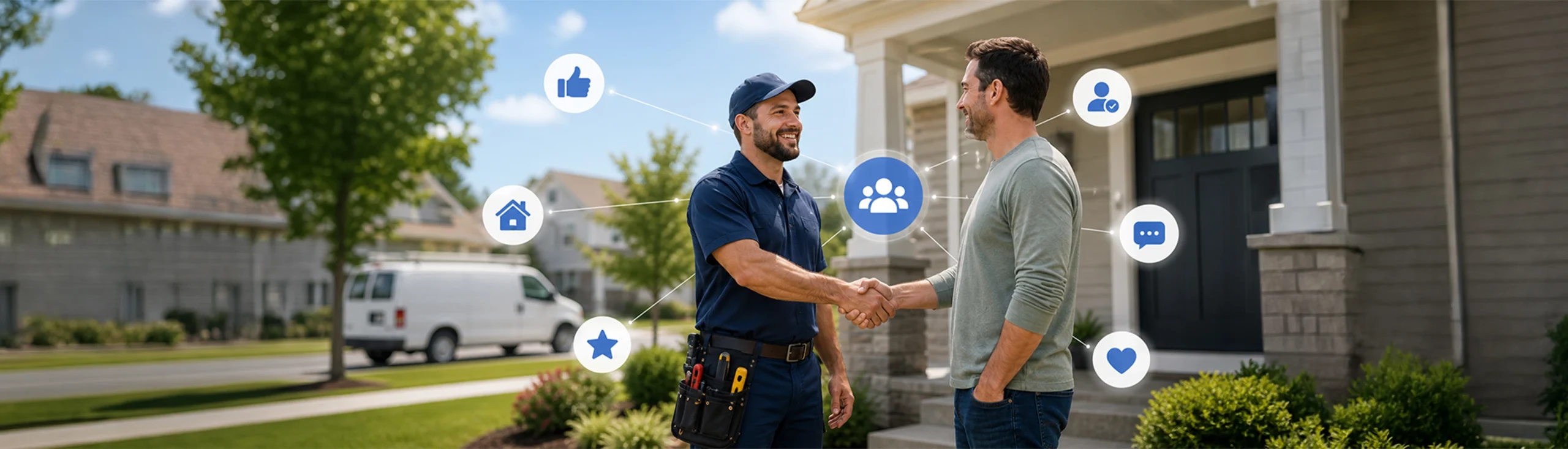
Every home service business owner knows that the best jobs come from the best clients, and the best clients tend to arrive through word of mouth. A neighbor mentions your name at a backyard cookout. A past customer tags you in a community Facebook group. A property manager passes your number to three new accounts without you spending a single dollar on ads.
That is the power of a referral. And unlike paid traffic that stops the moment your budget does, referral leads compound over time. The more you invest in building a referral-friendly business, the more your pipeline fills itself.
This guide, created by COLAB, is built for home service providers who want to stop leaving referrals to chance and start treating them as a deliberate, repeatable growth system. Whether you run an HVAC company, a landscaping operation, a plumbing crew, or a general contracting business, the framework here applies directly to your work.
What Is a Home Services Referral Program, And Why You Need One
A home services referral program is a structured system that encourages your existing customers to recommend your business to people in their network, and often rewards them for doing so.
The key word is structured. Most home service businesses get referrals at some point, but they get them passively. A customer had a great experience and happened to mention you. That is luck, not strategy.
A formal referral program turns that luck into a repeatable process by:
- Identifying the right moments to ask for a referral
- Giving customers an easy, low-friction way to refer you
- Offering a meaningful incentive that motivates action without cheapening your brand
- Following up consistently so referral opportunities don’t slip through the cracks
Why Referrals Outperform Most Other Lead Sources
Referral leads convert at a higher rate than cold traffic because trust is already built into the introduction. When someone’s neighbor recommends your plumbing company, that conversation carries a level of social credibility no ad can replicate.
Beyond conversion rate, referred customers also tend to:
- Require less time to close
- Have a higher average job value
- Be more loyal over the long term
- Refer others themselves, compounding your growth
Building a home services referral program is not just about getting more leads. It is about getting better ones.
Start Here: Build a Client Base That Naturally Refers You
Before any referral program, script, or incentive can work, the foundation has to be solid. Customers only refer businesses they genuinely trust, and trust is earned through the quality of the work and the experience surrounding it.
This is where many home service businesses skip ahead. They build a referral rewards structure before they have fixed the service gaps that are quietly killing word-of-mouth at the source.
Deliver Service Worth Talking About
The baseline for referrals is a job done right, done clean, and done on time. That sounds obvious, but the details matter more than most business owners realize. Arriving on time, communicating clearly when schedules change, leaving a job site cleaner than you found it, and following up to confirm the customer is satisfied, these are the behaviors that make customers feel good enough about you to put their own reputation on the line by recommending you.
Your customers are not just evaluating your technical work. They are evaluating whether recommending you would make them look good.
Set Expectations at Every Stage
A significant source of referral friction is unmanaged expectations. A customer who expected same-day service and got a two-day delay is not a hostile customer, they may have just needed a heads-up. Manage expectations clearly at booking, during the job, and at completion.
Three moments where expectation-setting matters most:
- At booking: Confirm the scope, timeline, and what the customer needs to prepare
- During the job: Communicate any changes, delays, or additional findings immediately
- At completion: Walk the customer through what was done and confirm their satisfaction before you leave
Make the Experience Memorable, Not Just Functional
Home service work is often invisible when it goes right. The furnace works. The pipes don’t leak. The lawn looks clean. That invisibility makes it easy for customers to forget how much they appreciated your work, which means they are less likely to mention you unprompted.
Small touches break through that invisibility. A handwritten thank-you card, a follow-up text two days after the job, or a seasonal check-in call are not gimmicks, they are relationship signals that keep your business top of mind when a neighbor or friend mentions they need the same work done.
How to Ask for Referrals Without Feeling Awkward
One of the most common reasons home service businesses don’t get more referrals is simple: they don’t ask. Not because they forgot, but because asking feels uncomfortable. It can feel like you’re putting your customer in an awkward position or implying that you need the help.
That discomfort is worth pushing through, because most satisfied customers are happy to refer a business they trust. They just need a nudge and a simple way to do it.
Timing Is Everything
The best time to ask for a referral is immediately after a positive moment, when a customer has just expressed satisfaction, left a good review, or told you directly that they are happy with the work.
Do not wait until the invoice is paid and the customer has moved on mentally. The emotional peak of a great experience is your referral window, and it closes fast.
The second-best time to ask is during a structured follow-up, which we’ll cover in a later section.
How to Ask: Keep It Direct and Low-Pressure
The most effective referral ask is conversational, not transactional. You are not pressuring a customer, you are extending an invitation.
| In person (at job completion):
“We really enjoyed working on this for you. If you know anyone else who could use [service], we’d love to help them too, and we’d really appreciate the introduction.” |
| Via text or email (post-job follow-up):
“Hi [Name], just checking in to make sure everything is working well. If you’re happy with the work, we’d be grateful if you passed our name along to anyone who might need [service]. It really means a lot to a small business like ours.” |
What Makes a Referral Ask Work
Three elements make a referral request land well:
- Specificity, Name the type of customer or situation you’re looking for (“anyone who’s had a recent plumbing issue” is more actionable than “anyone you know”)
- Ease, Give them something to share: a business card, a link, a short referral form
- Gratitude, Thank them regardless of whether they follow through. Appreciation reinforces the relationship
A Note on Scripting for Your Team
If you have technicians or field staff, they are your most direct referral touchpoint. A short, natural task built into their job completion routine, not a memorized pitch, is one of the highest-leverage moves a home service business can make. Train your team with a flexible script, not a rigid one.
How to Build a Formal Home Services Referral Program

Getting occasional referrals through good service and timely asks is a great start. But if you want referrals to become a reliable, scalable part of your business growth, you need a program, not just a habit.
A formal home services referral program gives your customers a clear, consistent way to send business your way. It removes ambiguity, sets expectations, and makes the process feel official enough that customers take it seriously.
Define the Structure Before You Launch
Before you promote anything, answer these four questions:
- Who qualifies? Is the program open to all customers, or only those who have used your service within a certain timeframe?
- What counts as a referral? Does the referred contact need to book a job, or just make an inquiry?
- When does the reward get delivered? At booking, at job completion, or after payment is received?
- What is the reward? Cash, discount, service credit, or something else? (More on this in the next section.)
Getting these details locked in before launch prevents confusion and protects you from rewarding referrals that don’t convert into real business.
Keep the Program Simple Enough to Explain in One Sentence
The most effective referral programs pass what’s called the “coffee shop test”, your customer can explain the program clearly to a friend while ordering coffee. If the rules require a paragraph to explain, simplify them.
| A clean example:
“Refer a friend who books a job with us, and you both get a $25 credit on your next service.” |
That is one sentence. Anyone can remember it. Anyone can repeat it.
How to Promote Your Program
A referral program that exists only in your head, or only on a page your customers never see, is not a program. It is a plan.
Promote it across every touchpoint:
- At job completion: Mention it verbally and hand over a card or flyer
- In your follow-up email or text: Include a short line and a direct link
- On your invoices and receipts: A footer line drives more action than most businesses realize
- On your website: A dedicated referral program page or form (covered in Section 7)
- On your Google Business Profile: Add it to your business description or post it as an update
Don’t Overthink the Technology
You do not need expensive software to run a referral program. A simple Google Form for referral submissions, tracked in a spreadsheet, is enough to start. As your volume grows, you can explore referral tracking tools, but the system matters far less than the consistency of promoting it.
Client Referral Program Ideas: Reward Options That Actually Work
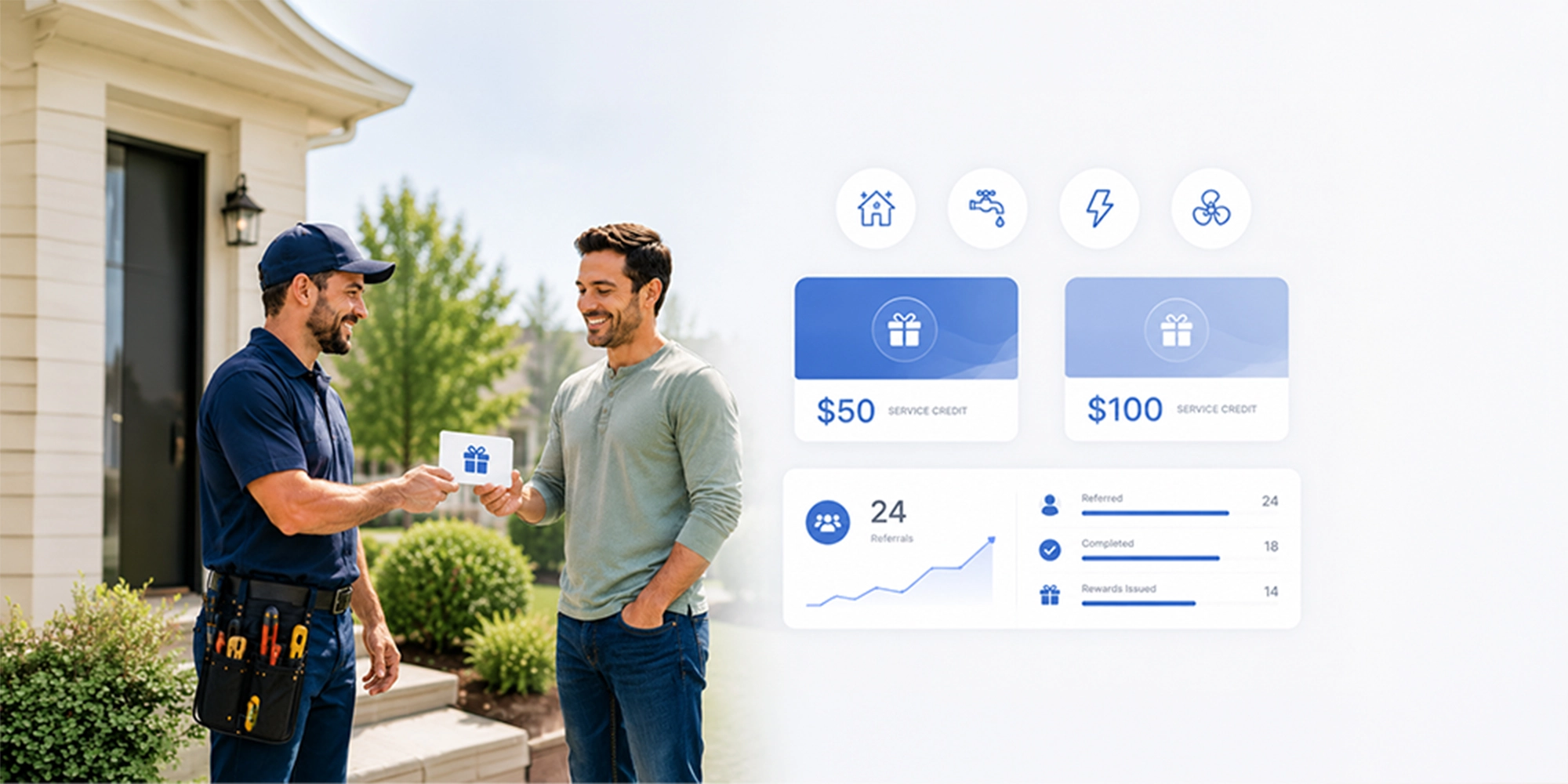
The reward is the part most home service businesses spend too much time worrying about, and get wrong in one of two ways. Either they offer something too generic to be motivating, or they offer something so valuable it becomes financially unsustainable.
The goal is a reward that feels meaningful to your customer without eroding your margins.
Cash Rewards vs. Service Credits vs. Added Value
Each reward type sends a different signal to your customer:
| Reward Type | Best For | Risk |
| Cash | High-ticket services (HVAC, remodeling) | Can feel transactional; attracts reward-hunters |
| Discount on next service | Recurring services (lawn care, cleaning) | Only valuable if customer plans to rebook |
| Service credit | Broad service ranges | Easy to redeem; feels like a gift |
| Added-value service | Premium positioning | Reinforces quality over price |
| Gift card (third party) | One-time service customers | Universally useful but no brand tie-in |
There is no universally correct answer. The right reward depends on your average job value, your service frequency, and the type of customer relationship you have.
Reward the Referrer AND the New Customer
One of the most effective, and underused, strategies in client referral program ideas is the double-sided reward: both the person who referred and the new customer receive something.
This works for two reasons:
- It gives your existing customer a genuine reason to make the introduction (“I get a credit and so do you”)
- It lowers the barrier for the new customer to book, because they arrive with an incentive already attached
A first-time referred customer discount can be the difference between an inquiry and a booked job.
What to Avoid
- Generic rewards, A branded pen or a thank-you card is appreciated, but it will not motivate a referral
- Rewards that are hard to redeem, If the process to claim a reward is confusing or requires multiple steps, customers won’t bother
- Rewards that undermine your pricing, A 40% discount as a referral reward signals that your standard pricing has room to be questioned
- Rewarding too early, Delivering a reward before the referred job is completed creates cash flow risk and invites abuse
Show Genuine Gratitude Beyond the Incentive
A reward is a transaction. Gratitude is a relationship. The businesses that build the strongest referral cultures are the ones that follow up personally, a quick phone call, a handwritten note, or a genuine thank-you text, every single time a referral is made, whether it converts or not.
That personal touch reinforces the behavior and deepens the loyalty of your best advocates.
How to Use Social Media to Drive Service Referrals
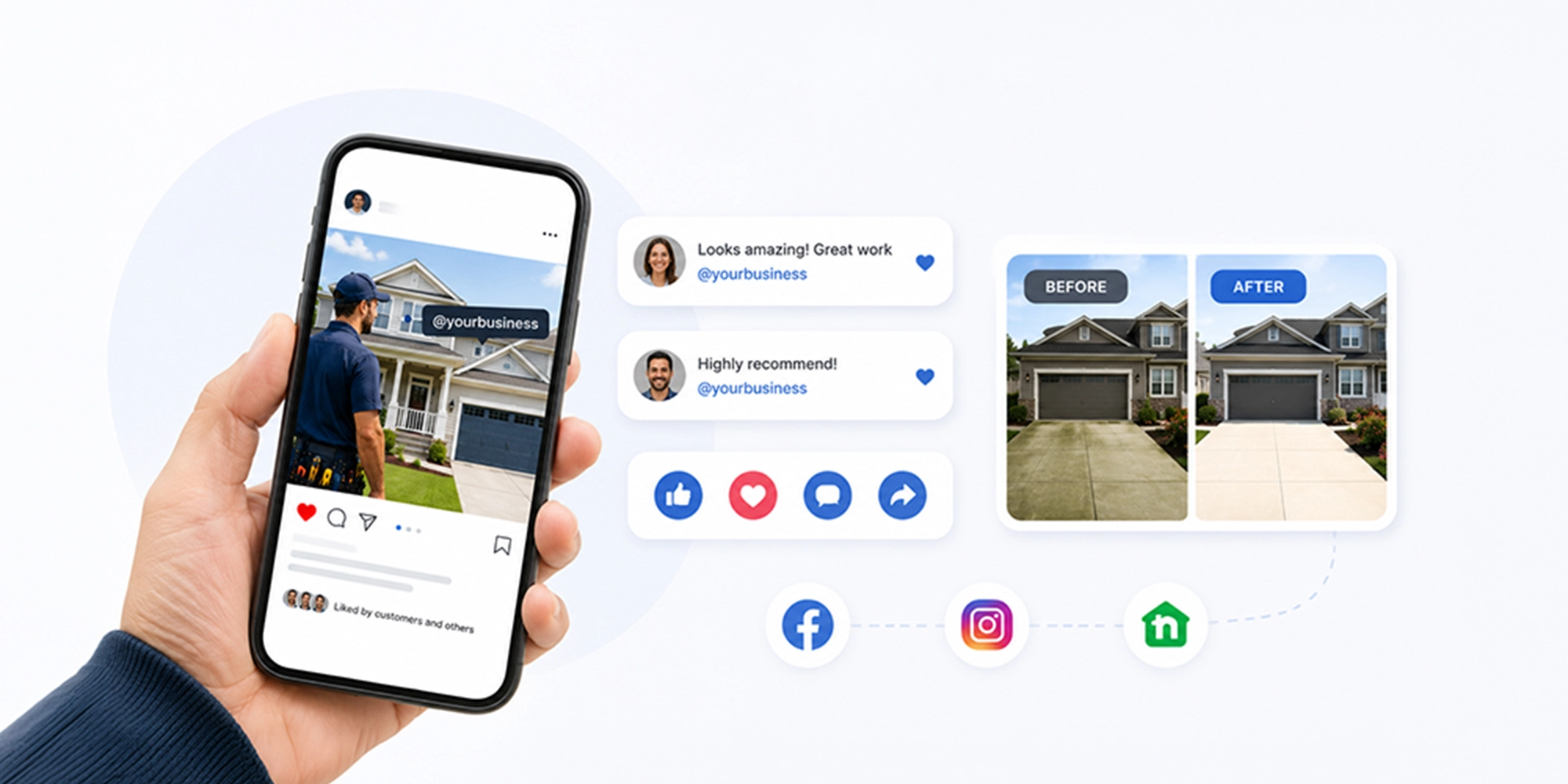
Social media is not a replacement for direct referral asks, but it is one of the most powerful amplifiers of word-of-mouth that a home service business has access to. The right post, at the right moment, can turn one satisfied customer into a dozen warm introductions.
The key is understanding what soci.;l…..≥≥…les on your business card or follow-up message
- Giving a small incentive for posts that tag your account (a service credit, a small gift)
Use Your Own Profiles to Prompt Referral Conversations
Your own social media presence is a referral tool when used correctly. Posting regularly with content that showcases your work, your team, and your values keeps you top of mind for past customers, so when a friend mentions they need your type of service, your name surfaces naturally.
Content that drives referral behavior:
- Before-and-after project photos, Visual proof of quality
- Customer shoutouts (with permission), Social validation for your audience
- “Know someone who needs this?” posts, A direct, low-pressure referral prompt embedded in regular content
- Seasonal reminders, “It’s HVAC tune-up season, who do you know who hasn’t had theirs done yet?”
The “Tag a Friend” Prompt
One of the simplest and most effective social referral tactics is to end certain posts with a direct ask:
“Know a homeowner who’s been putting off their [service]? Tag them below, we’ll make sure they’re taken care of.”
This creates visible, trackable referral activity in your comments section and exposes your business to new audiences through the tagged person’s network. It feels casual, but it is a deliberate referral mechanism.
Add Referral Touchpoints to Your Website
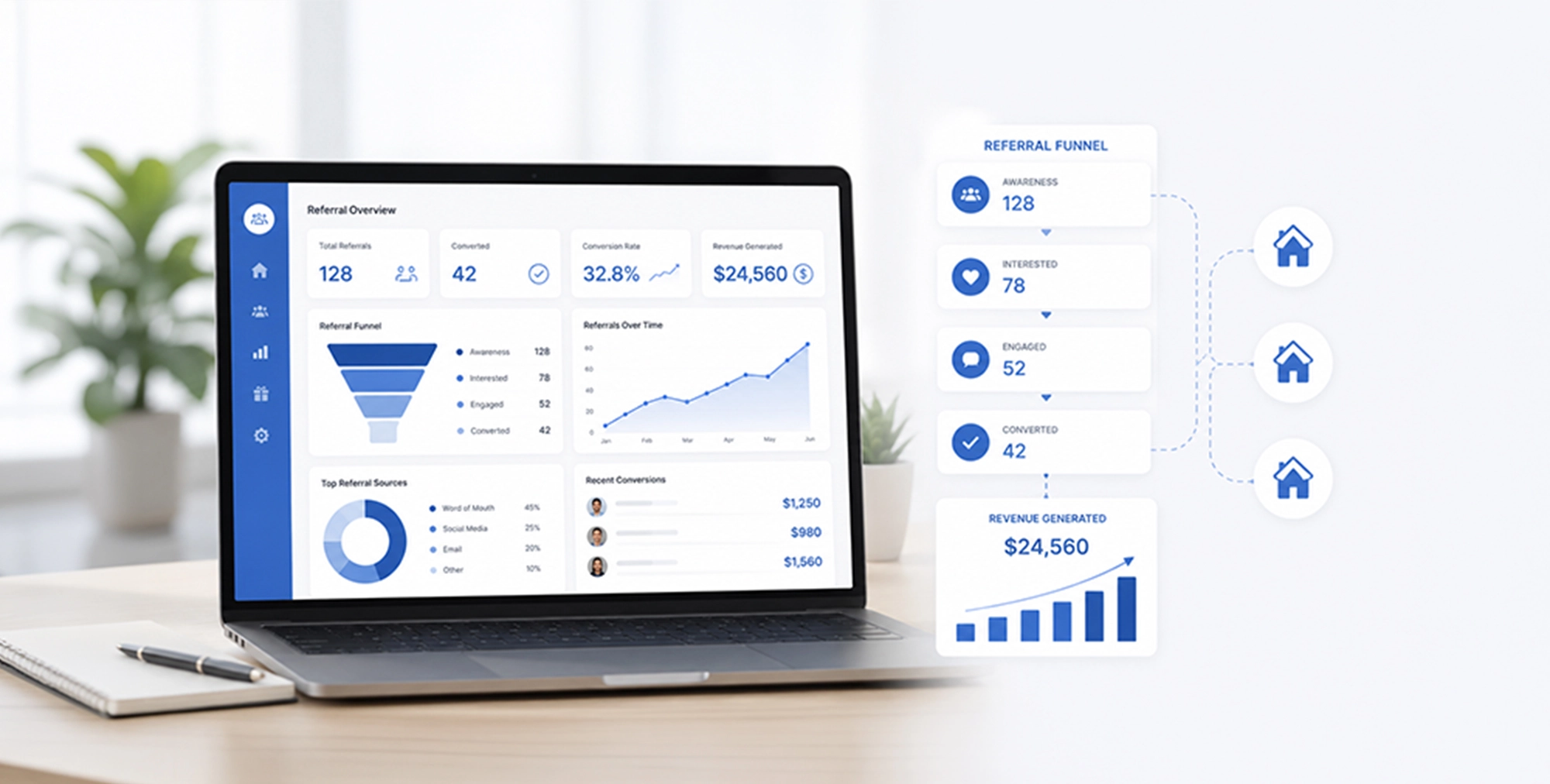
Most home service websites are built to convert strangers into first-time customers. That is important, but your website should also be working to activate the customers you already have. Adding referral touchpoints to your site turns it into a passive lead generation tool that works around the clock, even when your team is in the field.
Add a Dedicated Referral Submission Form
The single most impactful website addition for a referral program is a simple, dedicated form where customers can submit a referral directly. No phone call required. No email thread. Just a clean, low-friction entry point.
What your referral form should capture:
- Referrer’s name and contact information
- Referred contact’s name, phone number, and email
- Type of service the referred contact needs (optional but useful for follow-up)
- How the referrer would like to receive their reward (if applicable)
Keep the form short. Every additional field reduces completion rates. Five fields maximum is a reasonable benchmark.
Create a Dedicated Referral Program Page
A standalone page, not just a buried form, signals to your customers that your referral program is real, intentional, and worth their attention. This page should clearly explain:
- How the program works
- What the reward is
- How and when the reward is delivered
- Any terms or conditions in plain language
Optimize this page with your target keywords naturally embedded in the heading, body copy, and meta description. A page titled “Refer a Friend, [Your Business Name] Home Services Referral Program” is both user-friendly and search-visible for customers who may look you up after hearing about the program.
Embed Referral Prompts in High-Traffic Pages
Your referral program should not live only on its own page. Embed lightweight referral prompts across pages your customers already visit:
- Thank-you page after booking or inquiry: “Already a customer? Click here to refer to a friend.”
- Service pages: A sidebar or footer CTA linking to your referral form
- Contact page: A short mention beneath your main contact form
- Blog posts and resource content: Contextual CTAs placed naturally within relevant content
These placements require minimal effort but extend your referral program’s reach across the entire site without disrupting the primary conversion flow.
Make It Mobile-First
The majority of your customers will interact with your referral form on a mobile device, likely after reading a follow-up text you sent. If your form is not fully functional and visually clean on a phone screen, you will lose referrals at the final step. Test every form submission on mobile before you launch.
Train Your Team to Generate Referrals in the Field
Your office can build the best referral program in the industry, but if your field team does not know about it, or does not feel comfortable bringing it up, it will never reach its potential. The people on your crew who walk into a customer’s home every day are your most powerful referral asset. They are the face of your business at the moment trust is highest.
Build the Ask Into the Job Completion Routine
The referral request should not feel like an afterthought tacked onto the end of a service call. It should be a natural, expected part of how every job closes, just like handing over the invoice or confirming the work is complete.
A simple job completion routine that includes a referral moment:
- Walk the customer through the work completed
- Confirm they are satisfied and answer any remaining questions
- Hand over the invoice or receipt
- Mention the referral program briefly and naturally
- Leave a business card or referral card they can pass along
Step four does not require a sales pitch. It requires one sentence:
“We really appreciate your business. If you know anyone who needs [service], we’d love the introduction, and we’ll take great care of them.”
That is it. No pressure. No script memorization. Just a natural, human close.
Give Your Team the Right Tools
Field staff cannot promote a referral program they don’t fully understand. Before expecting your team to ask for referrals, make sure they:
- Know the program details clearly (reward amount, how it works, who qualifies)
- Have physical materials to leave with customers (referral cards, door hangers, or a QR code that links to your referral form)
- Know how to handle questions customers might ask (“When do I get my reward?”, “Does my friend get anything too?”)
A short team briefing, even fifteen minutes, is enough to align everyone. Revisit it quarterly or whenever the program changes.
Create a Culture, Not a Quota
Mandating referral requests with tracking quotas can backfire, it makes the interaction feel transactional and puts pressure on technicians in a way that shows. A better approach is to build referral requests into your company culture through positive reinforcement.
Recognize team members who generate referred jobs. Share referral wins in team meetings. Let your crew see the tangible business impact of their customer relationships. When staff understand that referrals directly support the company’s growth, and their own job security, the motivation becomes intrinsic rather than enforced.
Post-Job Follow-Up: The Referral Window Most Businesses Miss
The period immediately after a completed job is the highest-value window in your entire customer relationship. The customer has just experienced your service. The quality is fresh in their mind. Their satisfaction, if you delivered, is at its peak. And yet most home service businesses let this window close without taking any deliberate action.
A structured post-job follow-up sequence does two things simultaneously: it confirms customer satisfaction and positions your business for a referral before the moment fades.
The Follow-Up Timing That Works
Timing matters more than most businesses realize. Follow up too quickly and it feels automated. Wait too long and the emotional moment has passed.
The sweet spot for most home service businesses:
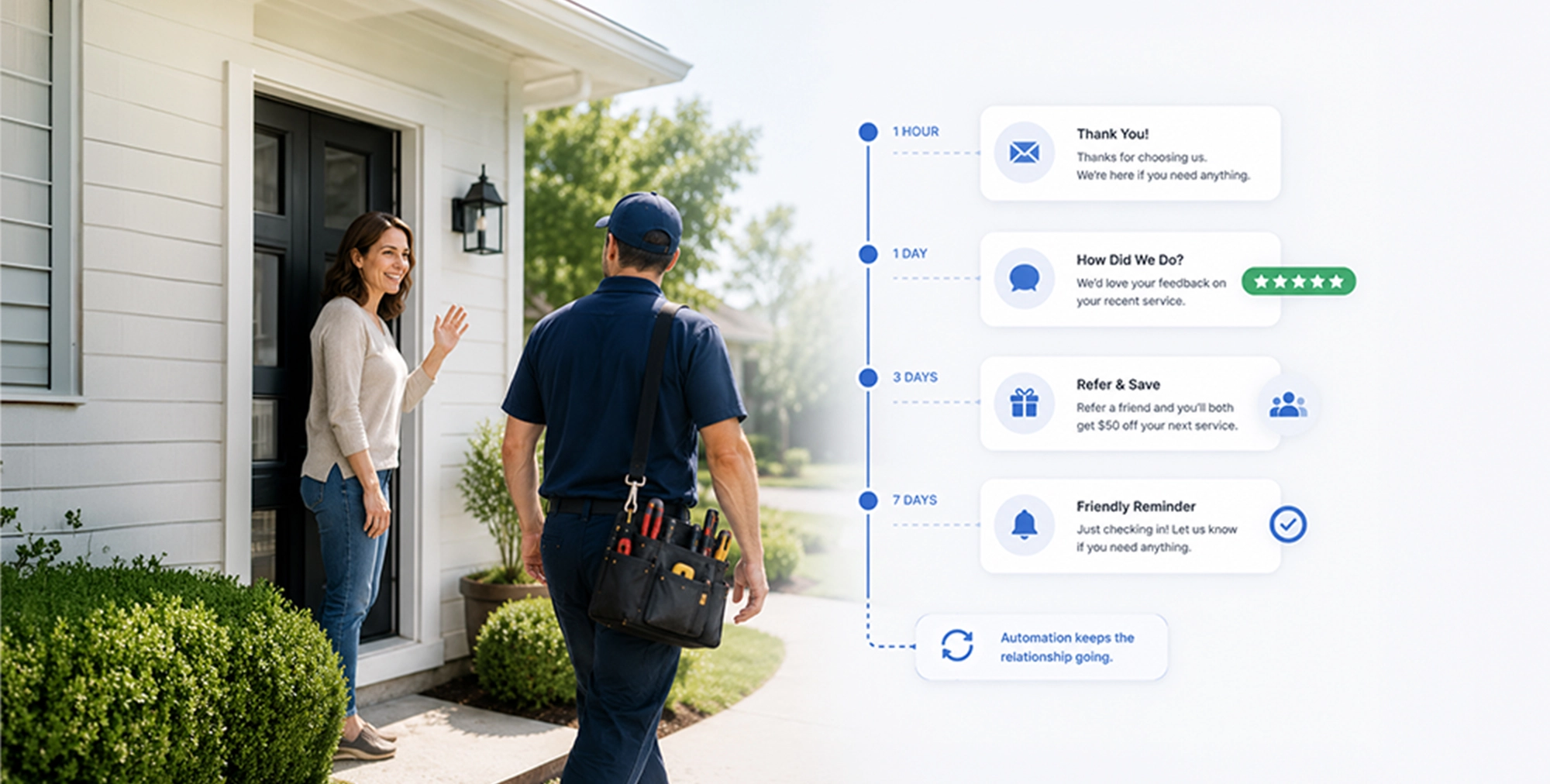
- 24 to 48 hours post-job: A short, personal check-in text or email confirming everything is working as expected
- 5 to 7 days post-job: A slightly warmer follow-up that includes a review request and a referral mention
- 30 to 90 days post-job: A seasonal or maintenance reminder that re-engages the customer and includes a passive referral prompt
Each of these touchpoints serves a dual purpose: it signals that you care about the customer beyond the transaction, and it keeps your business name visible at exactly the moment when conversations about home services tend to happen naturally.
What a High-Converting Follow-Up Message Looks Like
Your follow-up should never feel like a mass email blast. Even if you are using a template, the language should feel personal and specific to the job completed.
24–48 hour check-in (text):
“Hi [Name], this is [Your Name] from [Business]. Just wanted to make sure everything is working well after yesterday’s [service]. Let us know if you have any questions, we’re always here.”
5–7 day follow-up (email):
“Hi [Name], hope the [service] is holding up well. If you’ve been happy with the work, we’d really appreciate a quick Google review, it helps more than you know. And if you know anyone who could use [service], we’d love to help them too. Thanks again for trusting us with your home.”
Why Most Follow-Ups Fail
The most common follow-up mistakes in home service businesses:
- Generic messaging, Emails that start with “Dear Valued Customer” signal immediately that no one wrote this for you specifically
- Asking for too much at once, A follow-up that asks for a review, a referral, a rebooking, and a social share is overwhelming and gets ignored
- No clear next step, Every follow-up message should have one primary ask with one link or action
- Inconsistency, Following up after some jobs but not others means you are leaving referral opportunities on the table at random
Automate the Sequence Without Losing the Human Feel
Automation is not the enemy of personalization, it is the enabler of consistency. A simple CRM or even a scheduled text tool can fire your follow-up sequence automatically based on job completion date. What matters is that the message itself is written in a human voice, uses the customer’s name and service details where possible, and does not read like a robot sent it.
The goal is for every customer to feel like they received a personal check-in, even if the trigger was automated.
Build Referral Partnerships with Other Home Service Providers
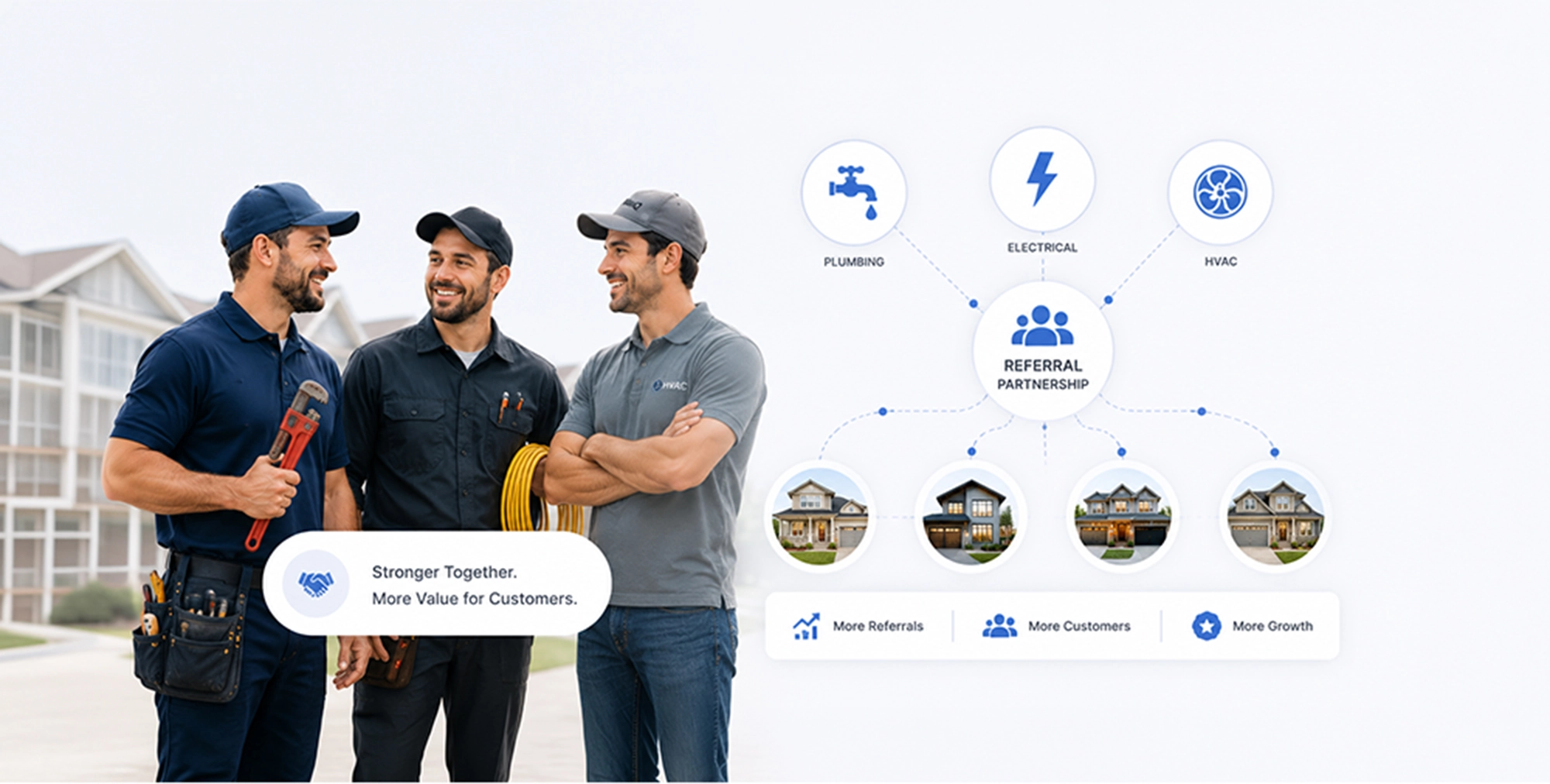
Not every referral has to come from a customer. Some of the highest-quality, most consistent referral relationships a home service business can build are with other businesses that serve the same homeowners, but in a completely different trade.
Think about the natural overlaps. A plumber finishes a job and notices the homeowner’s HVAC system is making noise. An electrician wraps up a panel upgrade and the customer mentions they’ve been meaning to repaint. A landscaper is on-site every week and hears about everything happening inside the house.
These are warm, contextual referral moments, and they happen every day in every market.
How to Identify the Right Partners
The best referral partners are businesses that:
- Serve the same homeowner demographic as you
- Offer a service that complements yours without competing with it
- Have a reputation for quality that reflects well on you when you make a mutual introduction
A few natural pairings:
- HVAC ↔ Plumber, electrician, insulation contractor
- Landscaping ↔ Pest control, irrigation specialist, fence installer
- General contractor ↔ Interior designer, painter, flooring installer
- Cleaning service ↔ Organizer, handyman, carpet cleaning
How to Structure the Partnership
A referral partnership does not need a formal contract to work. What it needs is:
- A clear mutual agreement that both parties will actively recommend each other
- A simple way to track referred jobs (a shared log or a quick text when a referral is sent)
- Occasional check-ins to keep the relationship warm and the referrals flowing
Start with one or two strong local partners before trying to build a wide network. Depth beats breadth in referral partnerships, one reliable partner who sends you two jobs a month is worth more than ten partners who send nothing.
How to Launch a Referral Program with Zero Budget
A referral program does not require software, a marketing agency, or a dedicated budget line. What it requires is intention, consistency, and a willingness to ask. If you are a newer business or working with limited resources, here is the leanest version of a referral program that still works.
The Zero-Budget Referral Starter Kit
- A referral ask script, Written out, practiced, and used by everyone on your team at every job close
- A simple business card, With a handwritten or printed note on the back: “Refer a friend and you both save $25 on your next service”
- A Google Form, Free, takes fifteen minutes to build, and gives customers a direct way to submit referrals online
- A follow-up text template, Saved in your phone and sent within 48 hours of every completed job
- A tracking spreadsheet, A simple Google Sheet logging who referred whom, when the job was completed, and whether the reward was delivered
That is your entire system. It costs nothing to build and nothing to run. The only investment is the reward itself, which only pays out when a referred job is completed, meaning it is entirely performance-based.
The One Habit That Makes It Work
Consistency. A referral system that is used on 30% of jobs delivers 30% of the results it could. Make the ask, send the follow-up, and log the referral every single time, without exception. That discipline, compounded over months, is what separates businesses that get occasional referrals from businesses that grow almost entirely through word of mouth.
How to Track and Measure Your Referral Program
A referral program you cannot measure is a referral program you cannot improve. Even a basic tracking setup gives you the visibility to know what is working, where referrals are coming from, and whether your rewards are driving the behavior you want.
Key Metrics to Monitor
| Metric | What It Tells You |
| Referral rate | Percentage of customers who refer at least one new contact |
| Referral conversion rate | Percentage of referred contacts who become paying customers |
| Referral revenue | Total revenue attributed to referred jobs in a given period |
| Reward redemption rate | How often customers actually claim their referral reward |
| Top referral sources | Which customers or partners send the most referrals |
How to Use the Data
Once you have a few months of data, look for patterns:
- Which service types generate the most referrals? Double down on the experience around those jobs.
- Which customers refer most frequently? Build a VIP relationship with your top advocates.
- Where are referrals dropping off, at the ask stage, the submission stage, or the conversion stage? Fix the leak at the source.
You do not need a dashboard or a dedicated analytics tool to start. A well-maintained spreadsheet, reviewed monthly, is enough to make meaningful program improvements.
How Reviews and Referrals Work Together
Online reviews and personal referrals are not separate strategies, they are two expressions of the same thing: a satisfied customer putting their credibility behind your business. The difference is the audience. A referral reaches one person directly. A review reaches everyone who searches for you.
Treating them as a unified system makes both more effective.
Ask for the Review First
For customers who are satisfied but not yet ready to refer to someone specific, a review request is a lower-friction first step. It gets them into the habit of publicly endorsing your business, which psychologically makes them more likely to recommend you in conversation as well.
A customer who has already written a five-star Google review has, in a sense, already made a public commitment to your quality. That commitment makes the next step, a personal referral, feel natural and consistent with what they have already said.
Connect Your Google Business Profile to Your Referral Strategy
Your Google Business Profile is the most visible proof point for referred customers doing their due diligence. When someone is referred to your business, the first thing they typically do is search your name. What they find, your review count, your rating, your photos, your responses to past reviews, either confirms the referral or creates doubt.
Keep your profile current, respond to every review professionally, and treat it as the landing page for every word-of-mouth recommendation you generate.
Build Your Referral Engine, One Job at a Time
Referrals do not happen at scale because you got lucky. They happen at scale because you built a system, one that delivers great work, asks at the right moment, rewards meaningfully, follows up consistently, and treats every satisfied customer as a growth asset.
The businesses that win on referrals are not necessarily the biggest or the best-funded. They are the most intentional. They turn every completed job into a potential introduction, and every introduction into a relationship.
At COLAB, we work with home service businesses that are ready to build marketing systems that generate compounding, long-term growth, not just traffic spikes. If you are ready to turn your referral strategy into a structured, scalable program, get in touch with our team and let’s build it together.
FAQs
Keep it brief, genuine, and tied to a positive moment. Right after a customer expresses satisfaction, in person or via follow-up, is the best time. A one-sentence ask that feels conversational and does not pressure them for an immediate answer lands far better than a formal pitch.
The right incentive depends on your average job value and service frequency. For recurring services, a discount on the next visit works well. For higher-ticket, less frequent work, a cash credit or a gift card tends to be more motivating. A double-sided reward, where both the referrer and the new customer benefit, consistently outperforms one-sided programs.
Start with a verbal ask at every job close, a basic Google Form for submissions, and a follow-up text template. Track referrals in a simple spreadsheet. The reward only costs you when a referred job is completed, so the program is self-funding from day one.
This varies significantly by industry, service area, and how actively you promote the program. Businesses that ask consistently, follow up reliably, and offer a meaningful incentive typically see referral-sourced leads grow into a significant share of new business within the first six to twelve months of a structured program.
No. Your best referral advocates are typically your most satisfied, longest-standing customers. Focus your energy on nurturing those relationships. A smaller group of highly engaged advocates will consistently outperform a broad, low-engagement program.